Inbound warehouse operations are one of the hardest areas to automate.
Many warehouses have already automated storage, sorting, picking and packing. But at the dock, loose truck and container unloading, subsequent sorting and palletizing are still often manual. Workers enter trailers in the heat, lift (often heavy) cartons repeatedly, and move goods onto conveyors, pallets, or staging areas.
This creates a clear bottleneck. The work is physically demanding, repetitive, and difficult to staff, especially in high-volume e-commerce, retail, manufacturing, and 3PL operations.
That is why truck and container unloading automation is becoming an important part of modern warehouse robotics.
Below, we look at four of the most relevant companies in this space that focus on the unloading, followed by honorable mentions that are shaping inbound warehouse automation.
What is Robotic Truck and Container Unloading?
When the truck contains cartons that are already on pallets, the unloading is pretty straightforward. In this blog, we focus on loose freight, where cartons are laid on the floor. With loose loading, the container can be filled at 100% with cartons, making overseas shipping more sustainable.
Loose freight, however, needs to be taken out of the container when it reaches its destination, sorted into different SKUs, and eventually stacked onto pallets for subsequent storage and handling.
Those are labor-intensive tasks that are typically done manually. Focusing on the unloading, this requires handling of heavy cartons inside the container at conditions that in summer exceed 40°C.
Why Truck and Container Unloading is Hard to Automate?
Truck and container unloading may look simple, but it is one of the hardest warehouse tasks to automate.
An automated system, such as a robot, needs to handle unknown box positions, mixed carton sizes, unstable loads, damaged packaging, poor lighting, tight spaces, awkward items, and goods that shift during transport. Unlike a fixed robotic cell, a trailer is unpredictable. Every load can be different. This is why unloading automation has developed more slowly than other areas of warehouse robotics.
However, better 3D vision, (physical) AI, motion planning, vacuum gripping, teleoperation, and mobile robotics are making the category more practical.
The Big 4 in Truck and Container Unloading
1. Boston Dynamics – Stretch
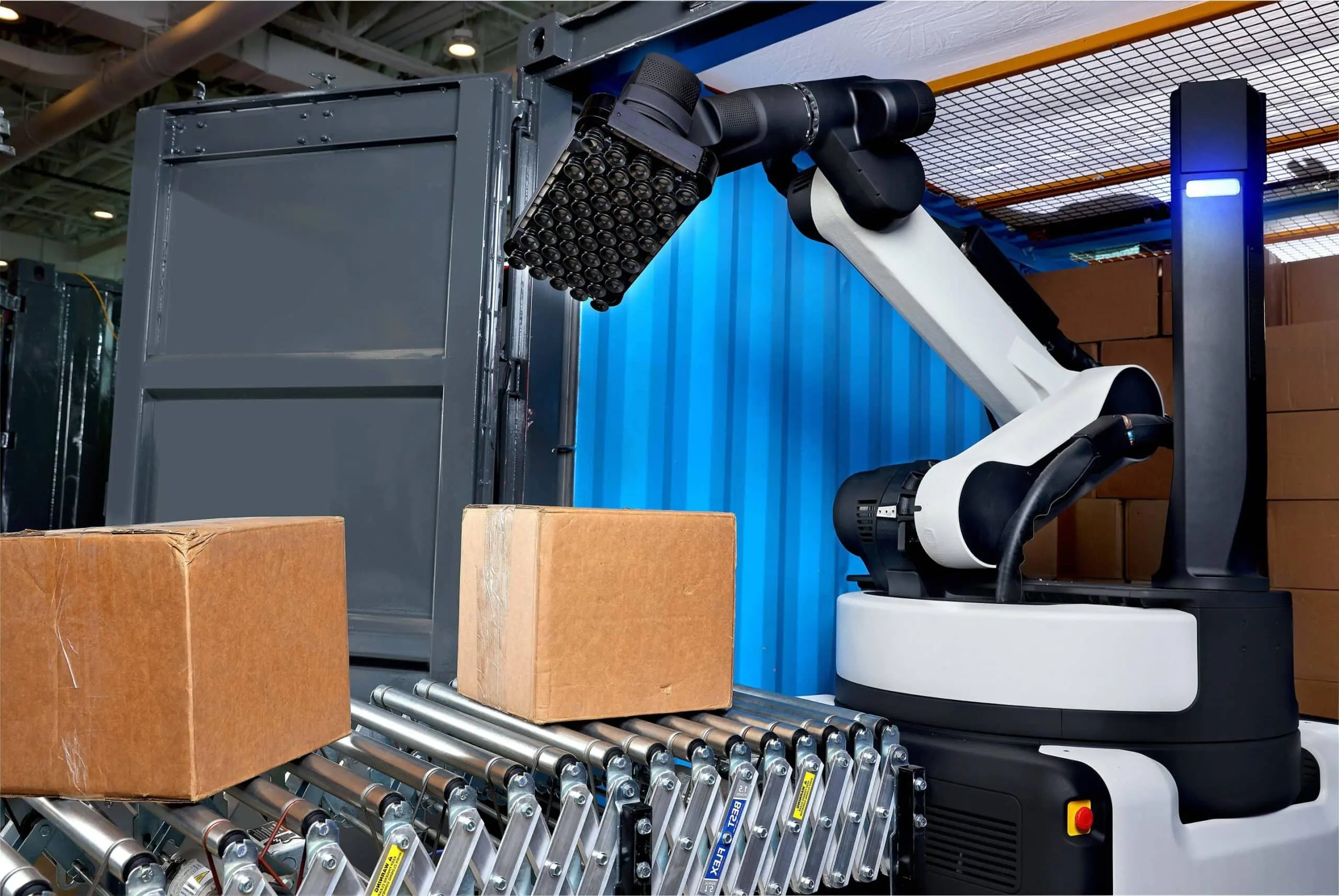
Boston Dynamics is one of the most recognizable names in robotics, and Stretch is one of the best-known systems for robotic truck, trailer, and container unloading.
Stretch combines a mobile base, robotic arm, vision system, and vacuum gripper to identify boxes, pick them, and place them onto a conveyor. Boston Dynamics states that Stretch can handle a wide range of package types and sizes, including standard and highly graphical cartons, with packages up to 25 kg.
Stretch is especially relevant for parcel, e-commerce, 3PL, and retail distribution operations with high volumes of loose-loaded cartons.
A recent deployment example comes from Lidl. According to Modern Materials Handling, after pilot testing, the grocery company is rolling out 22 Stretch robots to automate unloading of floor-loaded cases at multiple import warehouses by mid-2026.
2. Dexterity – Mech
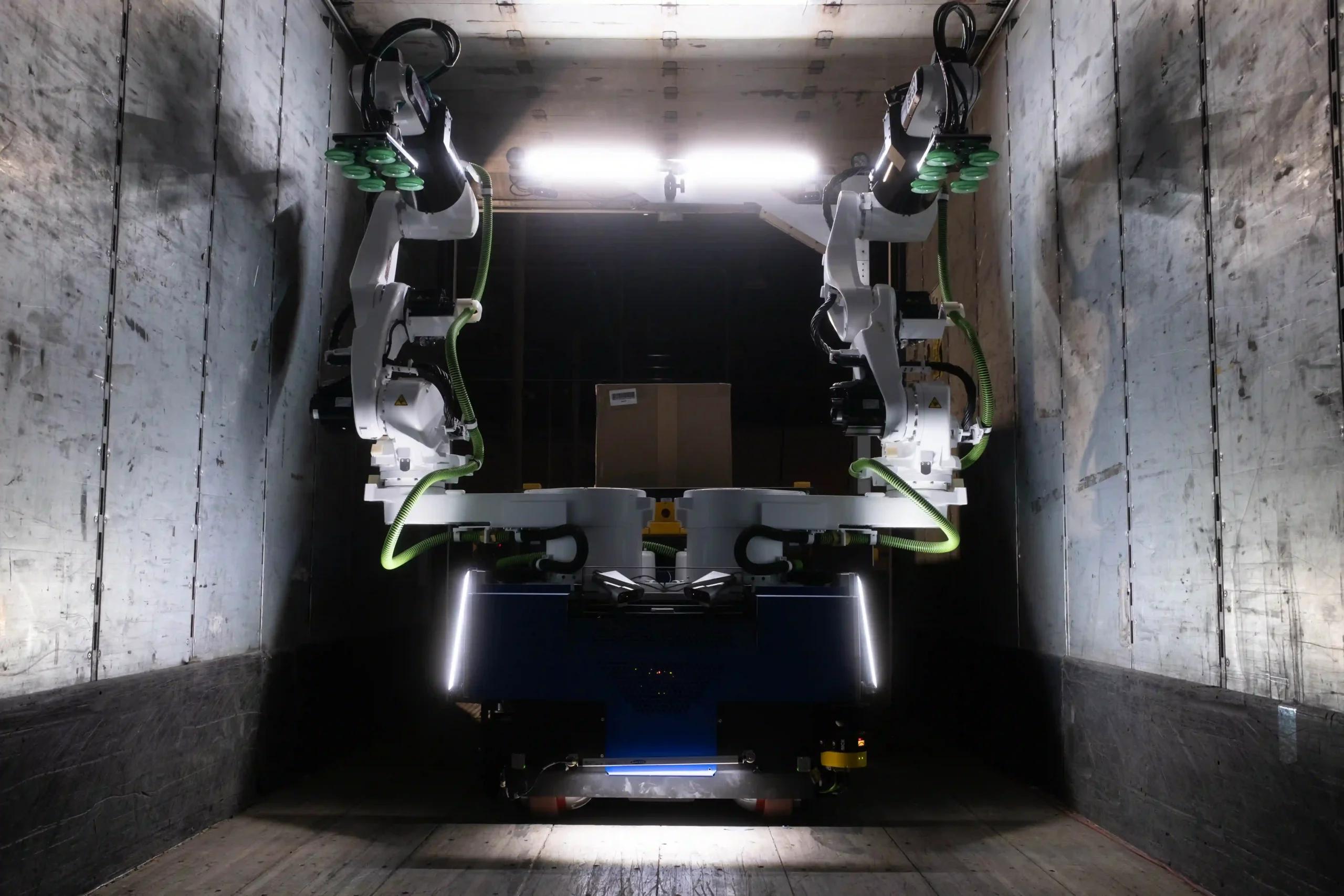
Dexterity is another important company to watch, especially with Mech, its industrial “superhumanoid” robot.
It is a dual-arm mobile manipulator for logistics tasks, with a strong emphasis on truck (un)loading and broader material handling. Kawasaki Heavy Industries states that it developed the robotic arms used on Mech, describing them as 8-axis arms designed to provide greater range of motion inside narrow truck cargo spaces. Each arm has a maximum payload capacity of 30 kg.
Mech is not only a truck unloading robot. It is designed as a powerful, general-purpose industrial robot for logistics applications, including truck loading, palletizing, and other material handling tasks.
This makes Dexterity interesting because its approach is broader than a single unloading use case. Inbound unloading rarely exists in isolation. Goods need to be unloaded, sorted, moved, palletized, or prepared for the next warehouse step.
Therefore, its strength is flexibility. Instead of solving only one narrow process, Dexterity is building robotic systems that can support several warehouse workflows. This could become increasingly important as warehouses move from isolated automation projects to connected, end-to-end material flows.
3. Pickle Robot – Robotic Trailer and Container Unloading
Pickle Robot focuses specifically on robotic unloading of trailers and containers filled with non-palletized goods.
Its system picks boxes from inside trailers or containers and places them onto its built-in conveyors, helping reduce one of the most physically demanding tasks in warehouse operations.
Pickle is especially relevant for warehouses with frequent floor-loaded trailers, mixed cartons, parcel flows, retail distribution, and e-commerce inbound operations.
Pickle’s strength is its specialization. The company is focused directly on the unloading problem rather than offering a broad warehouse automation portfolio.
The challenge is that inbound freight is messy. Cartons can shift during transport, arrive damaged, or be stacked unpredictably. This makes trailer unloading a complex mix of perception, gripping, motion planning, and warehouse integration.
Recently, Pickle reportedly secured a major order from UPS for around 400 truck-unloading robots, a strong signal of confidence from one of the world’s largest logistics companies.

4. Contoro – Autonomous Trailer and Container Unloading
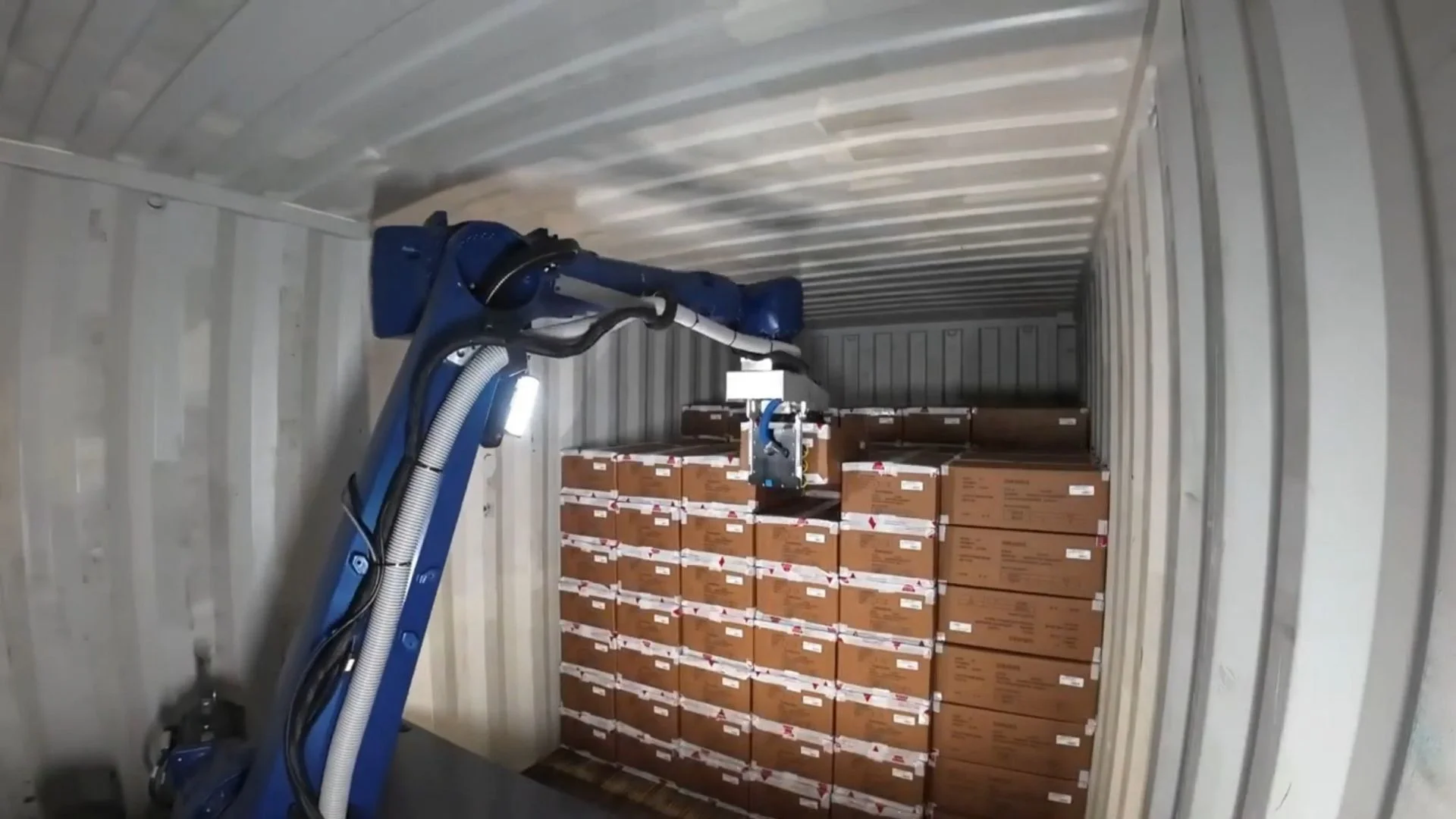
Contoro focuses on autonomous unloading of non-palletized boxes from trucks and shipping containers.
Its approach combines AI with human-in-the-loop support and teleoperation. This is important because trailer and container unloading involves many edge cases. Loads shift, cartons arrive damaged, and every trailer can look different. Furthermore, unlike the previous ones, Contoro has a special gripper that creates vacuum on 2 sides of the box, making it more effective and suitable for heavier cartons.
By combining automation with remote human support when needed, Contoro aims to make robotic unloading more practical in real warehouse environments.
Contoro is especially relevant for 3PLs, distribution centers, and warehouses with high labor dependency at the receiving dock.
Its positioning is interesting because it reflects the reality of warehouse automation: full autonomy is difficult in unstructured environments. A hybrid model that combines AI, robotics, and human support may be a practical path for many inbound operations.
Honorable Mentions
The following companies are also worth mentioning because they play an important role in truck, trailer, container, and inbound warehouse automation. They may not all compete directly with the top four, but they are relevant to the future of unloading and dock operations.
XYZ Robotics
XYZ Robotics is also active in truck and container unloading with its Rocky robot systems, including RockyOne and RockyLight.
The solution is designed for loose-loaded cartons in trailers and containers. It can adapt to different case and container conditions, pick multiple cartons at once, and place them individually onto a conveyor. This makes it relevant for inbound operations where cartons need to move from the trailer into a more structured warehouse flow for scanning, sorting, and palletizing.
Anyware Robotics – Pixmo
Anyware Robotics develops Pixmo robots for unloading boxes from containers and trucks. The company targets the same core pain point as many of the top players: reducing manual labor at the receiving dock and making unloading more predictable.
Unlike the previous ones who use an industrial robot arm, Anyware is using a cobot from Fanuc, making the overall solution more lightweight. Pixmo combines an autonomous mobile base with a force-sensing collaborative robotic arm, suction-based case handling, 3D perception, and AI-powered motion planning.

Mujin – TruckBot
Mujin is well known for intelligent robot control technology, and TruckBot is its solution for trailer and container unloading.
TruckBot is designed around telescopic conveyor-based unloading. Unlike other robotic unloading systems that use a standalone robotic arm to pick cartons and drop them onto a separate conveyor, TruckBot works more like a robotic telescopic conveyor: it extends deep into the trailer or container and uses a specially designed vacuum end effector to pull cartons from the load wall into the conveyor flow.
This makes it relevant for warehouses that already use conveyor-based dock infrastructure and want to automate the most labor-intensive part of unloading. Mujin states that TruckBot can reach up to 16 meters into a truck trailer or shipping container and handle boxes up to 23 kg, including mixed-SKU loads and more complex packing conditions.
Mujin’s strength is its robotics intelligence, including perception, motion planning, and autonomous control. It also fits well into broader warehouse automation, where unloaded cartons still need to be scanned, sorted, conveyed, stored, or palletized.
Berkshire Grey – Scoop
Berkshire Grey’s Scoop is a robotic trailer unloading solution designed for mixed package flows (that do not include sensitive cases).
Scoop combines bulk unloading with robotic picking, which makes it different from systems that rely mainly on item-by-item carton handling. It actually works like a scoop utensil, scooping cartons from the floor of the container. It has two robot arms which have a secondary functionality in the overall system: They just drop the boxes on the floor to scoop them. Quite a chaotic process, yet effective, unless you work with fragile stuff.
It is especially relevant for parcel, package, and high-throughput distribution environments where reducing manual dock labor and improving throughput are major priorities.

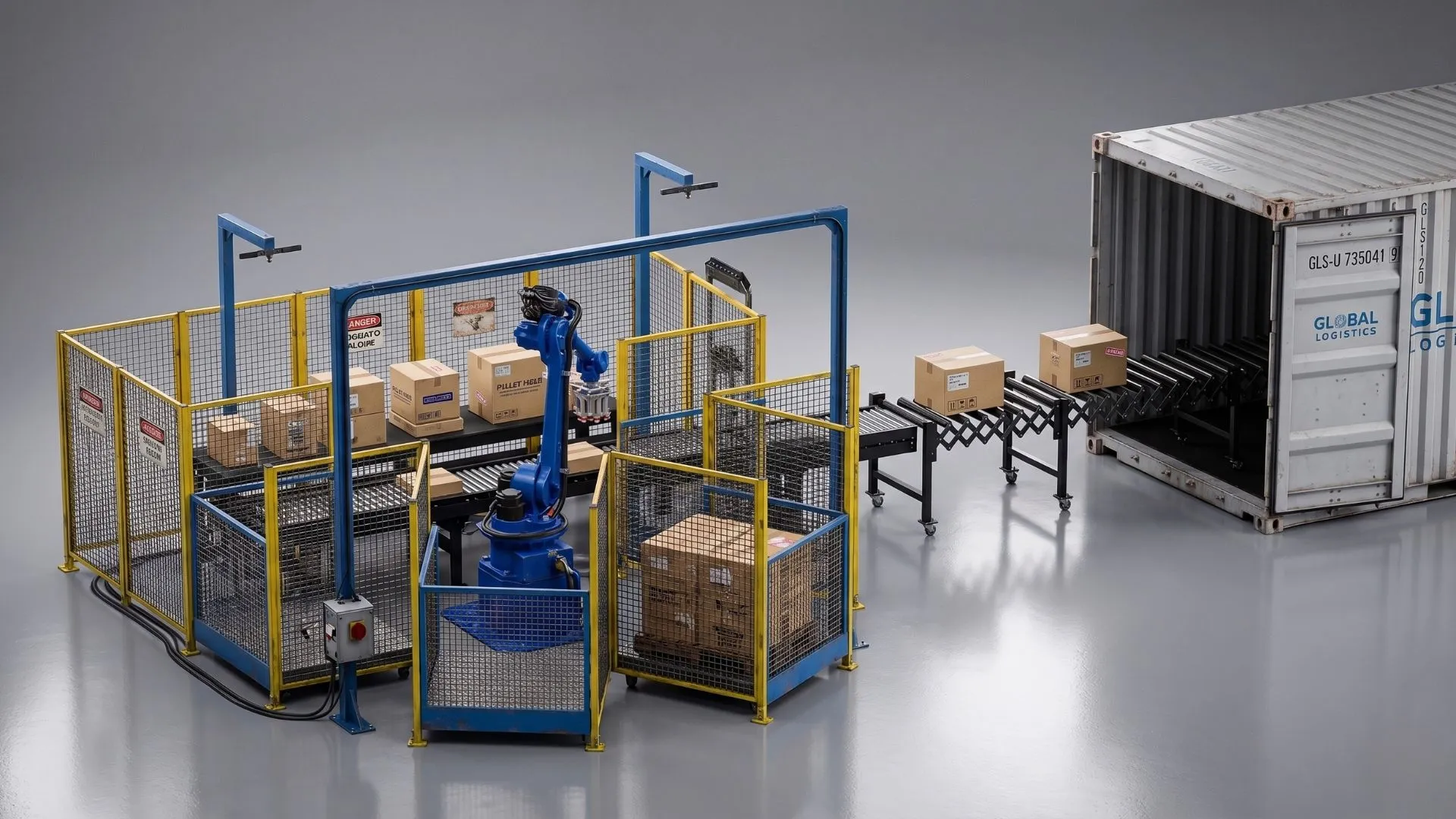
How Automated Unloading Connects to Palletizing
Unloading is only the first step of the inbound flow.
Once goods leave the truck or container, they need to be scanned, sorted, stored, staged, or palletized. If unloading is automated but palletizing remains manual, the bottleneck may simply move downstream.
This is why companies should look at inbound automation as a complete flow:
- Where do cartons go after unloading?
- Do they need to be sorted by SKU or destination?
- Are there any parcels that need to be flipped (repositioned) before palletizing?
- Are they palletized as single-SKU or mixed-SKU pallets?
- Is the flow sequenced or unsequenced?
- Can downstream systems handle the speed of automated unloading?
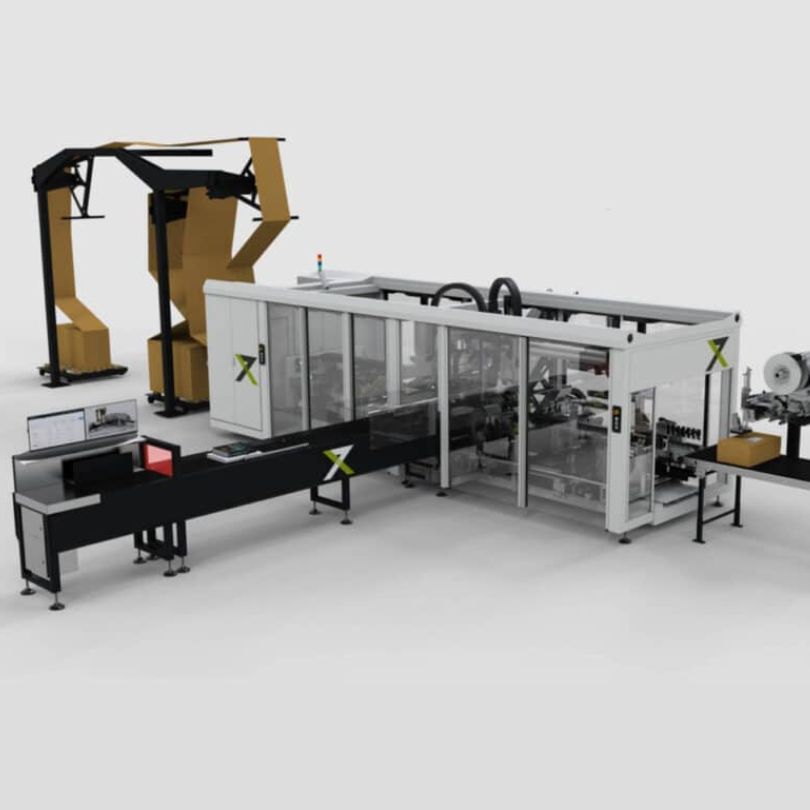
This is where the AnyStack® Palletizer becomes highly relevant. AnyStack focuses on robotic palletizing, including autonomous inbound and on-the-fly mixed palletizing for outbound operations. In an automated inbound workflow, unloading systems bring goods into the warehouse, while palletizing systems organize them for storage, shipping, or the next operational step.
In simple terms, unloading automation solves the “getting goods out of the trailer” problem. Robotic palletizing solves the “what happens next” problem.
Final Thoughts
Truck and container unloading is becoming one of the most important automation opportunities in inbound warehouse operations.
Boston Dynamics, Dexterity, Pickle Robot, and Contoro are four of the most relevant companies to watch, each approaching the challenge from a different angle. Around them, companies like XYZ Robotics, Anyware Robotics, Mujin, and Berkshire Grey show that the category is evolving quickly and that there is no single way to solve the unloading problem.
Some systems focus on mobile robotic unloading. Others combine Physical AI with teleoperation. Others connect unloading with palletizing or use bulk movement to improve throughput.
The key takeaway is simple: inbound automation should not be viewed as a single machine. It should be viewed as a connected material flow.
The most successful warehouses will connect unloading with conveying, scanning, sorting, palletizing, and internal transport, thus moving from manual dock work to more predictable, automated inbound operations.