Which Fits Your Warehouse Operations?
Moving parcels between warehouse processes is one of the first areas companies look to automate.
Cases need to move from picking to palletizing. Finished pallets need to reach wrapping, storage or outbound staging. Production areas need regular replenishment without relying entirely on forklifts.
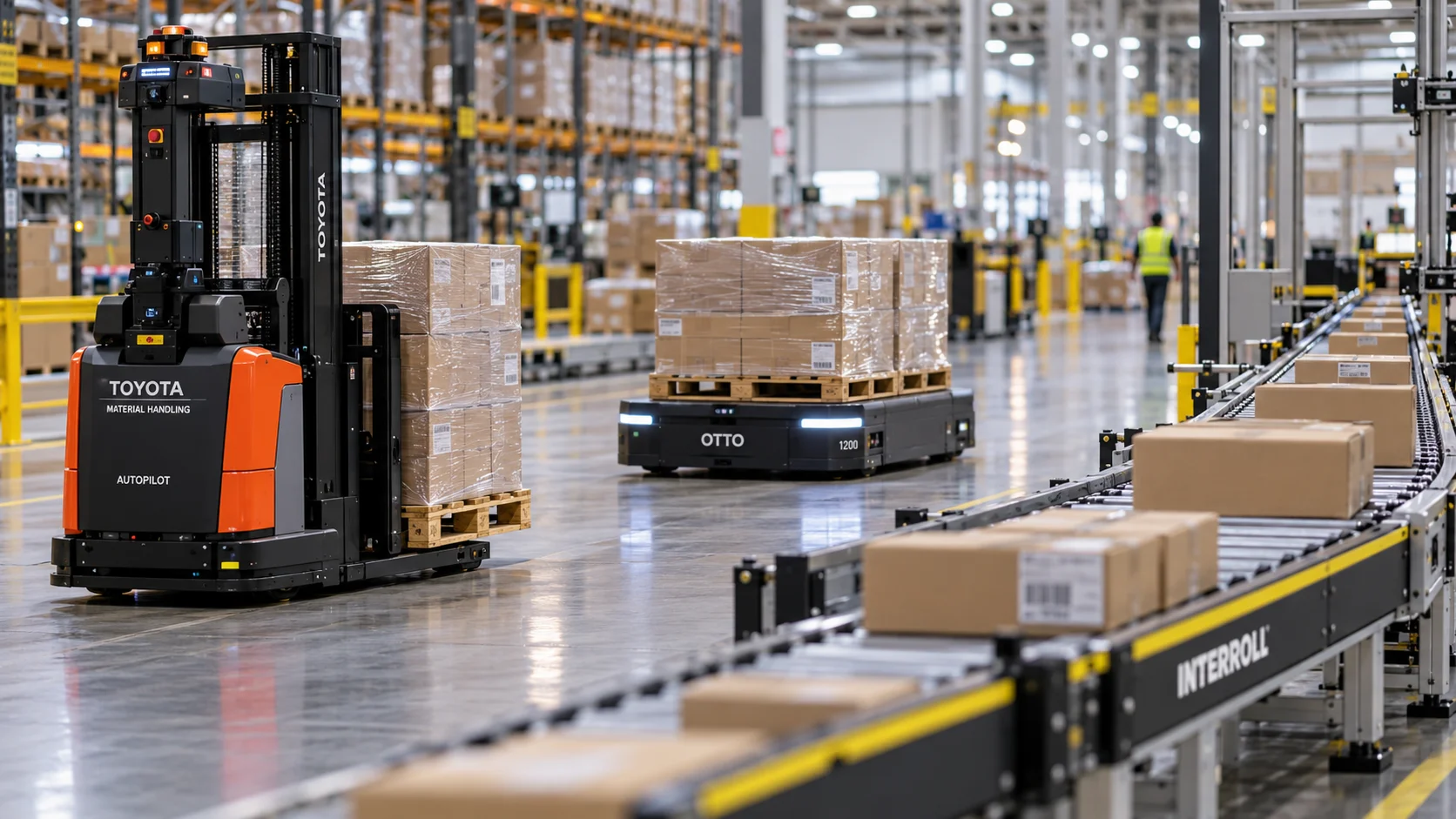
Three technologies are commonly used for these tasks:
- Autonomous Mobile Robots (AMRs)
- Automated Guided Vehicles (AGVs)
- Conveyor systems
They all automate internal transport, but they solve different problems.
The key question is not simply which technology is better?
It is: Which technology best matches the flow, volume and flexibility of your warehouse?
AMR vs. AGV vs. Conveyor at a Glance
AMR | AGV | Conveyor | |
Route | Dynamic | Usually predefined | Fixed |
Flexibility | High | Medium-High | Low |
Infrastructure | Limited | Some route/navigation infrastructure | Fixed mechanical infrastructure |
Best for | Operational fluctuations and/or changing destinations | Repetitive pallet transport | Continuous high-volume flows |
Expansion | Add robots / change routes | Add vehicles / modify routes | Extend conveyor & redesign |
Typical loads | Pallets, carts, totes | Pallets and heavy loads | Cases, totes and pallets |
In practice, the boundaries between AMRs and modern AGVs are becoming less clear. Some newer automated vehicles offer increasingly advanced navigation. For warehouse operators, the more useful question is therefore how the system behaves, rather than what the supplier calls it.
What is an AMR?
An Autonomous Mobile Robot (AMR) navigates through a warehouse using technologies such as LiDAR, cameras, mapping and onboard navigation software. Unlike a traditional guided vehicle, an AMR can typically determine its own route within an approved operating area and react when the preferred route is blocked. This makes AMRs useful when materials need to move between multiple locations or when warehouse flows change regularly.

For example, a finished pallet could be collected from a palletizing cell and sent to:
- A stretch wrapper
- An automated storage system
- A quality-control station
- A specific outbound staging lane
The destination can change from one pallet to the next.
Examples of AMR suppliers include:
- MiR – Mobile Industrial Robots
- OTTO by Rockwell Automation
- OMRON
- Geek+
- Jungheinrich
The robots themselves vary considerably. AMRs are particularly attractive in brownfield warehouses, where installing long sections of fixed conveyor infrastructure may be difficult.
What is an AGV?
An Automated Guided Vehicle (AGV) also transports materials automatically, but generally operates along predefined paths. Traditional AGV navigation can use technologies such as:
- Magnetic tape
- Floor markers
- Reflectors
- Laser guidance
- Predefined virtual routes
This makes AGVs particularly suitable for repetitive transport tasks where the pickup point, destination and route remain relatively stable.

A typical example might be:
Production line → finished-goods area → pallet storage
In this type of application, the ability to dynamically calculate a completely new route may not provide much additional value.
Major intralogistics companies offering automated vehicle systems include:
- Jungheinrich
- Toyota Material Handling
- Daifuku
- Dematic
- SSI Schäfer
Where Conveyors Fit
Conveyors take a completely different approach. Rather than allowing the transport system to travel to the load, conveyors create a permanent route for the load to follow. That lack of flexibility can also be their biggest advantage.
When thousands of cartons repeatedly follow the same route, conveyors can provide continuous and highly predictable material flow with minimal maintenance required.
They are especially useful for:
- Cases and cartons
- Totes
- Parcels
- Pallets
- Feeding automated machinery
- Accumulating products between processes
Major conveyor and warehouse automation suppliers include Interroll, Caljan, Itoh Denki, Intralox, Dorner, and Bosch Rexroth.

Why Conveyors Are Often Best for Feeding a Palletizer
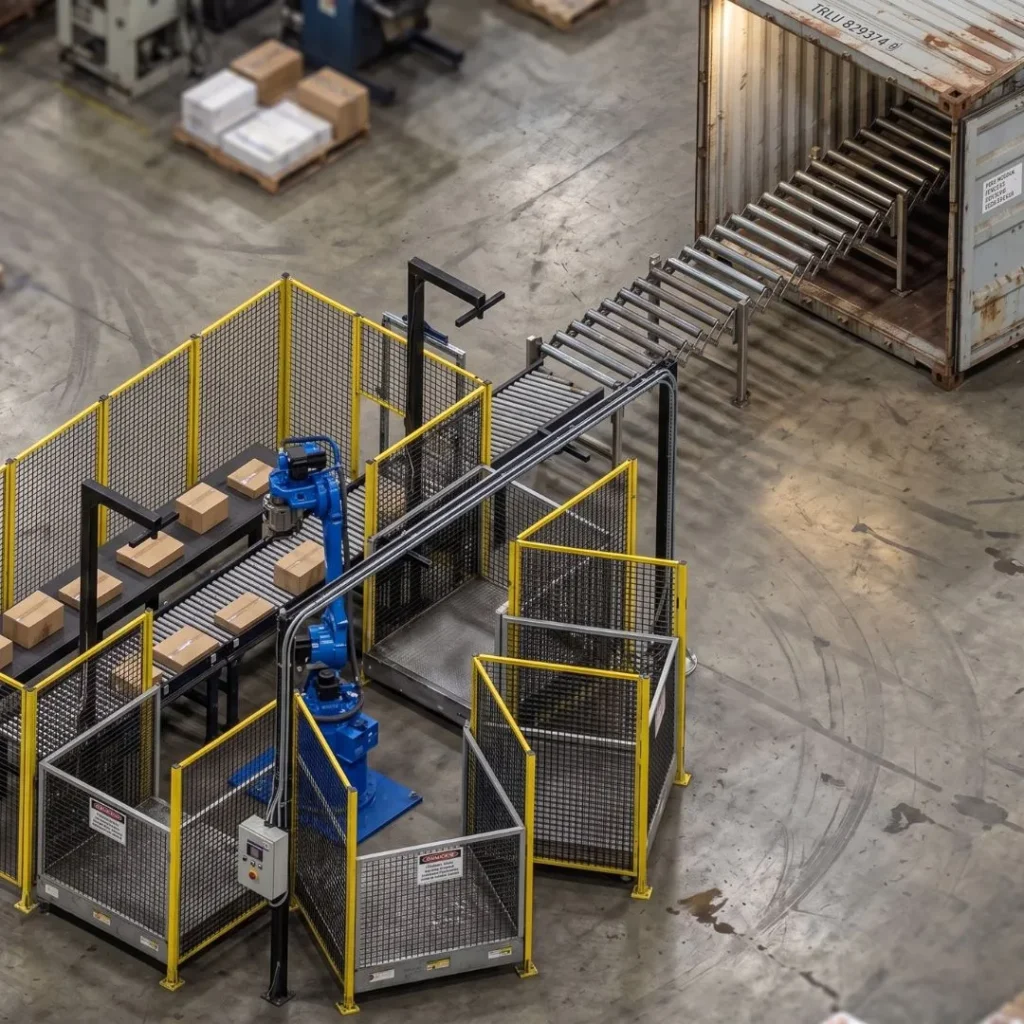
Consider a warehouse where cartons move from picking toward a robotic palletizing station.
The flow is always:
Picking → identification → buffer → palletizer
In this application, conveyor technology has an important advantage.
The conveyor does not just transport cartons. It can also:
- Control spacing
- Accumulate cases
- Create buffer capacity
- Merge flows
- Divert products
- Present cartons consistently to the robot
This becomes particularly important in mixed-SKU palletizing, where the palletizing system needs to manage continuously arriving cases.

With Progressive Robotics’ AnyStack®, for example, incoming boxes do not need to be arranged into a predetermined palletizing sequence upstream.
Instead, the system uses a zoned conveyor buffer together with 3D perception and pallet-state information to determine how incoming cases should be handled and placed.
Here, the conveyor is not simply transportation infrastructure. It is part of the robotic process itself.
What About the Pallet Transfer?
Once the pallet is complete, the material-flow problem changes. Instead of moving many individual cartons, the warehouse now needs to transport one complete pallet. This is where AMRs or AGVs can become especially interesting.
Imagine a palletizer producing loads for several destinations. One completed pallet may need to go to a stretch wrapper. The next may need to go directly to outbound staging. Another may need to enter an automated storage system. Rather than building conveyor routes connecting every possible destination, a mobile robot can transport each pallet according to its assigned task.
This type of application is already being used commercially.
For example, OTTO describes a deployment at Mauser Packaging Solutions where OTTO 1500 AMRs transport loads from conveyor systems to stretch wrapping. According to OTTO’s case study, the operation replaced an earlier AGV setup and significantly increased the number of transport missions possible between charging cycles.

That is a good example of where mobile robots can complement fixed automation rather than replace it.
AMR vs. AGV vs. Conveyor: Which one Should you Use?
The answer depends on:
- Throughput requirements
- Travel distance
- Number of destinations
- Number of vehicles
- Load/unload time
- Traffic
- Charging requirements
- Required accumulation
- Upstream and downstream equipment
Choose a conveyor when:
The route is fixed, volumes are high and loads need to move continuously.
Typical example: cartons travelling from picking or sortation to a palletizing system.
Choose an AGV when:
The flow is repetitive and heavy loads follow predictable routes.
Typical example: pallets travelling repeatedly between production and storage.
Choose an AMR when:
There are multiple destinations, routes may change, or installing fixed infrastructure would limit warehouse flexibility.
Typical example: completed pallets travelling from robotic palletizers to different wrappers, storage locations or outbound staging areas.
Consider a hybrid system when:
Different sections of the warehouse have fundamentally different transport requirements.
For many automated warehouses, this is the most practical architecture.
The important metric is therefore not the maximum speed of a conveyor or mobile robot. It is: How many required loads can the complete system move per hour without creating a bottleneck?
A Hybrid Approach Often Makes the Most Sense
Modern warehouses increasingly combine transport technologies.
A typical automated outbound flow could look like this:

Here, each technology does what it is best suited to do. The conveyor provides high-throughput, controlled case flow. The palletizer builds the load. The mobile robot provides flexibility once the completed pallet needs to travel through the warehouse.
This is also why the question should rarely be framed as:
“Should we use conveyors or AMRs?”
In many warehouses, the better answer is both.
Honorable Mention: GreyOrange – Smart Conveying Meets Mobile Robotics
An interesting example of the hybrid approach comes from GreyOrange, whose GreyMatter-powered Sortation & Smart Conveying solution combines robotic sortation, smart conveying and AI-driven orchestration. Rather than relying exclusively on fixed conveyor infrastructure, GreyOrange uses intelligent software to coordinate different automation technologies and adapt material flows to changing operational demands. It demonstrates how the future of intralogistics isn’t necessarily about choosing between conveyors and mobile robots, but making different technologies work together as one intelligent system.

Five Questions to Ask Before Deciding
Before selecting any transport technology, map the actual material flow.
Ask:
- What are we moving?
Cartons, totes, pallets or roller cages? - How frequently does it move?
Ten movements per hour require a very different solution from hundreds or thousands. - Does every load follow the same route?
Fixed flows favour conveyors. Changing destinations favour mobile robotics. - Will the warehouse layout change?
This can be especially important for 3PLs and rapidly growing operations. - What happens before and after the transport step?
A highly efficient transport system still creates problems if the palletizer, wrapper, storage system or loading dock cannot accept the load.
Look at the Complete Material Flow
AMRs, AGVs and conveyors should not be evaluated as isolated pieces of equipment. Their value depends on how they connect the processes around them.
A robotic palletizer may be capable of handling high case volumes, but if cartons cannot reach it consistently, the robot waits. Likewise, if completed pallets are not removed fast enough, the palletizing process eventually stops.
The goal should therefore be to design the complete warehouse flow, choosing fixed automation where material movements are predictable and flexible transportation where routes or destinations change.
In palletizing applications, that can mean using conveyors to manage the controlled flow of incoming cases, and AMRs or AGVs to transport completed loads through the rest of the warehouse.
Looking to automate your warehouse?