Which One Is Right for Your Automation Project?
Choosing the right robotic arm is one of the most important decisions when investing in palletizing automation. While 4-axis robots have long been the industry standard for high-speed palletizing, modern manufacturing and logistics environments increasingly demand greater flexibility. In this guide, we’ll explain the differences between 4-axis and 6-axis robotic arms, when each option makes sense, and why AI-powered palletizing systems are changing how businesses think about robotic automation.
What You’ll Learn
- What “robot axes” actually mean
- The differences between 4-axis and 6-axis robotic arms
- When a 4-axis robot is the better choice
- When a 6-axis robot provides significant advantages
- Why parcel flipping and re-orientation matter
- How AI and machine vision improve palletizing performance
- Which robot manufacturers dominate the market
- How Progressive Robotics approaches intelligent palletizing
Understanding Robot Axes
One of the most common misconceptions in industrial automation is that more robot axes automatically mean a better robot. In reality, the number of axes simply determines how many degrees of freedom the robotic arm has. Each axis represents an independent movement that allows the robot to position its end effector (gripper, vacuum tool, clamp, etc.) in different locations and orientations.
Think of your own arm:
- Your shoulder moves in multiple directions.
- Your elbow bends.
- Your wrist rotates.
- Your hand changes orientation.
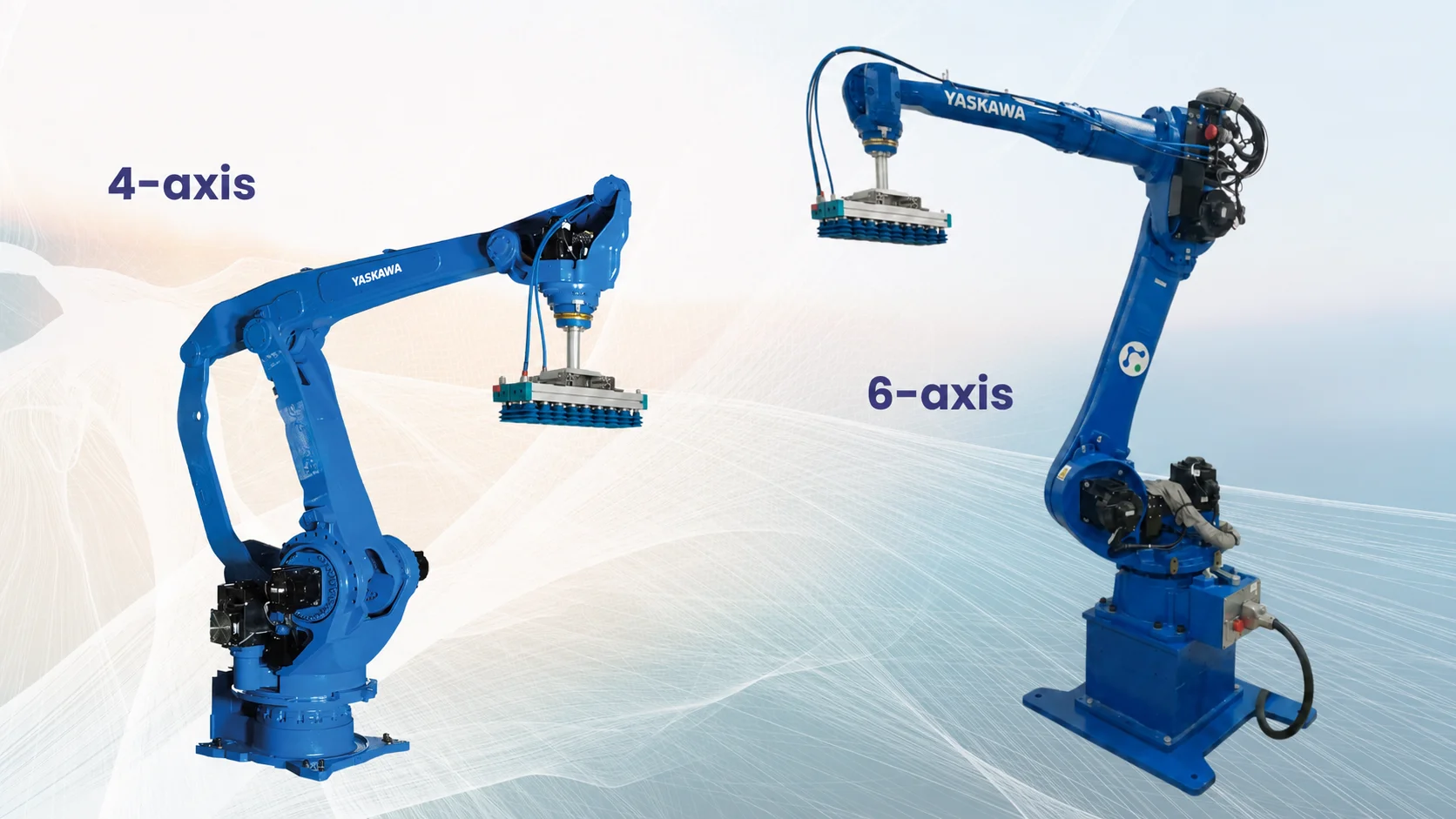
Industrial robots work in a similar way. A 4-axis robot has four controlled movements, making it exceptionally efficient for repetitive pick-and-place tasks. A 6-axis robot adds two additional wrist movements, allowing it to rotate, tilt, and orient products in virtually any direction. Those extra degrees of freedom become invaluable when products don’t arrive perfectly aligned.

Why Most Palletizing Robots Use 4 Axes
There is a reason why many palletizing cells around the world rely on 4-axis robots. They were specifically engineered for one purpose: Move products from Point A to Point B as quickly and consistently as possible. When every carton arrives with the same orientation and every pallet follows the same stacking pattern, a 4-axis robot is extremely efficient.
Why Are 4-Axis Robots Faster?
A key reason 4-axis palletizing robots can achieve higher speeds is their lower moving inertia. With fewer joints and motors, the robot’s moving structure can be lighter, meaning the motors have less mass to accelerate, decelerate, and change direction during each cycle. This allows the robot to perform rapid, repetitive movements with less energy and shorter cycle times. In applications where the required movements are relatively simple, the reduced mechanical complexity of a 4-axis robot can therefore translate into higher throughput compared with a similarly sized 6-axis robot.
Advantages of 4-Axis Robots
- High palletizing speeds
- Excellent repeatability
- Simpler programming
- Lower purchase cost
- Lower maintenance requirements
- Reduced energy consumption
- Shorter commissioning time
For manufacturers producing the same products day after day, these advantages often translate directly into a faster return on investment.
Popular 4-Axis Palletizing Robot Models
Several robot models offer highly capable palletizing robots.
Some of the best-known include:
- FANUC
- ABB Robotics
- KUKA
- Yaskawa Motoman
These manufacturers have spent decades optimizing dedicated palletizing robots capable of handling heavy payloads with exceptional speed and reliability.
When a 6-Axis Robot Becomes the Better Choice for Palletizing
Modern logistics and distribution centers are becoming increasingly dynamic. They no longer handle only one product in one orientation, but instead process a growing variety of parcels, cartons, and SKUs with different sizes, shapes, and orientations.
Today’s facilities often deal with:
- Mixed SKU production
- Frequently changing packaging
- Random parcel orientations
- E-commerce fulfillment
- Logistics automation
- Vision-guided picking
- Flexible manufacturing cells
These environments demand more than simple vertical pick-and-place movements. They require dexterity, and this is where a 6-axis robotic arm excels.

The Biggest Advantage: Product Re-Orientation
Imagine cartons arriving on a conveyor. Some face forward, some are rotated, some have labels upside down, and others arrive sideways after passing through upstream conveyors. A traditional palletizing robot may simply stack each box exactly as it receives it.
A 6-axis robot has another option as it can:
- Rotate the parcel
- Tilt it
- Flip it
- Correct its orientation
- Place it exactly where it should be
Instead of adapting the pallet to the incoming product, the robot adapts the product to the pallet. This capability dramatically improves pallet quality while reducing manual intervention.
Why Parcel Flipping Matters in Robotic Palletizing
How parcel flipping solves the biggest operational headaches in robotic palletizing?
Better Pallet Stability
Some cartons are structurally stronger when stacked in a specific orientation. Rotating them before placement produces more stable loads.
Correct Label Orientation
Retailers and distribution centers often require outward-facing labels. Re-orienting packages ensures easier barcode scanning and inventory management.
Mixed Product Pallets
When different package sizes share the same pallet, proper orientation helps maximize space utilization.
Damaged or Unstable Packages
Some parcels should never be stacked upside down. A 6-axis robot can automatically detect and correct incorrect orientations.
Why Progressive Robotics Uses 6-Axis Robots
At Progressive Robotics, we intentionally selected a 6-axis robotic architecture for our palletizing solutions. The reason isn’t simply that a 6-axis robot has more joints. It’s because real production environments rarely behave perfectly. Our AI-powered palletizing systems (AnyStack®) are designed to handle situations where parcels arrive with varying orientations, dimensions, or stacking requirements.
As a result, AnyStack® Palletizers can:
- Re-orient cartons before placement
- Flip parcels into the correct position
- Adapt to changing pallet patterns
- Handle mixed-product palletizing
- Maintain stable stacking even when upstream processes introduce inconsistencies (e.g., in inbound operations after container unloading)
Rather than limiting the system to standard palletizing alone, this flexibility allows our customers to automate a broader range of real-world scenarios while future-proofing their investment.
AI Makes the Difference – Not Just More Axes
A common mistake is to think that the robotic arm alone determines system performance. In reality, the intelligence behind the robot often has an even greater impact. Modern palletizing combines robotics with artificial intelligence and machine vision.
Nowadays AI can help determine:
- Optimal grasp points
- Package dimensions
- Product classification
- Pallet pattern optimization
- Collision-free trajectories
- Dynamic stacking strategies
- Orientation correction
- Automatic recovery from unexpected situations
Instead of following a rigid sequence of programmed positions, intelligent palletizing systems can continuously adapt to changing production conditions. This is where AI delivers measurable value in warehouse automation.
Machine Vision Completes the Picture
Machine vision acts as the robot’s eyes. Industrial cameras continuously analyze incoming parcels and provide real-time information about:
- Position
- Orientation
- Dimensions
- Barcode location
- Surface quality
Combined with AI algorithms, this allows the robotic system to determine whether a parcel requires rotation or flipping before palletizing. The result is a more autonomous and resilient palletizing process.
Choosing the Right Robot Isn’t Only About Axes
Several additional factors influence robot selection.
Payload
Can the robot safely lift your heaviest products?
Industrial palletizing robots commonly support payloads ranging from 10 kg to well over 500 kg.
Reach
A robot must comfortably reach:
- Conveyor
- Pallet (up until the desired pallet height for parcel placements)
- Intermediate positions
- Future pallet layouts
Longer reach often enables greater flexibility without relocating equipment.
Cycle Time
High-speed production sites, and warehouses or distribution centers with high inbound and outbound traffic may prioritize throughput above everything else. Other industries may value flexibility more than raw speed.
End-of-Arm Tooling
The gripper plays a critical role. Depending on the application, palletizing robots may use:
- Vacuum grippers
- Mechanical clamps
- Hybrid grippers
- Adaptive gripping systems
Selecting the correct end effector can significantly improve handling reliability.

Common 6-Axis Robot Manufacturers
Many leading robotics companies produce high-performance 6-axis industrial robots suitable for palletizing and material handling.
These include:
- Yaskawa Motoman
- Universal Robots
- FANUC
- ABB Robotics
- KUKA
Each manufacturer offers different payload capacities, reach options, controller capabilities, and software ecosystems. The best choice depends on the application rather than the brand alone.
4-Axis vs. 6-Axis for Palletizing: Side-by-Side Comparison
Feature | 4-Axis Robot | 6-Axis Robot |
Speed | Excellent | Very Good |
Programming Complexity | Low | Moderate |
Purchase Cost | Lower | Higher |
Maintenance | Lower | Moderate |
Standard Palletizing | Excellent | Excellent |
Parcel Flipping | Limited | Excellent |
Product Re-Orientation | Limited | Excellent |
Mixed SKU Handling | Moderate | Excellent |
Future Flexibility | Moderate | Excellent |
AI & Vision Integration | Good | Excellent |
Which Robot Should You Choose?
There is no universal answer.
A 4-axis robot is often the best solution when:
- Products always arrive in the same orientation
- Throughput is the highest priority
- Production rarely changes
- Cost optimization is critical
A 6-axis robot becomes the stronger choice when:
- Products require re-orientation
- Parcel flipping is needed
- Multiple SKUs are processed
- Vision systems guide the robot
- Future flexibility is important
- Production environments evolve frequently
The best automation project begins by understanding the process – not by selecting the robot with the most axes.
Conclusion
Selecting the right robotic arm for palletizing is about much more than counting axes. A 4-axis robot remains the ideal choice for many high-throughput applications where products are consistent and predictable. However, modern manufacturing and logistics increasingly demand flexibility. Mixed products, changing packaging formats, and randomly oriented parcels require robotic systems that can do more than simply move boxes from one point to another.
By combining the dexterity of a 6-axis robotic arm with AI-driven decision-making and machine vision, businesses can automate complex palletizing tasks, improve load quality, reduce manual intervention, and prepare for future production challenges.
At Progressive Robotics, we believe the best palletizing solution isn’t defined by the robot alone – it’s defined by the intelligence behind it. That’s why our AI-powered palletizing systems leverage 6-axis robots to provide the flexibility needed for parcel re-orientation, flipping when required, and adaptive palletizing in real-world industrial environments.
If you’re planning your next palletizing automation project, choosing the right robot architecture today can deliver greater efficiency, scalability, and return on investment for years to come.
Frequently Asked Questions
Which is best for mixed-case palletizing: a 4-axis or 6-axis robot?
For mixed-case palletizing, a 6-axis robot is generally the better choice when different products require different orientations, stacking patterns, or parcel re-orientation.
Which is best for single-case palletizing: a 4-axis or 6-axis robot?
For single-case palletizing, a 4-axis robot is typically the better choice because it offers high speed, lower inertia, and lower cost when products arrive consistently oriented.
Why would a palletizing robot need to flip boxes?
Flipping allows the robot to correct package orientation, improve pallet stability, ensure labels face the correct direction, and handle products arriving randomly on conveyors.
Can one robot handle multiple products?
Yes. Combined with AI, machine vision, and the right gripper, modern robotic palletizing systems can automatically adapt to different package sizes, shapes, and orientations.