

Why Industrial-Grade AI Needs a Buffer to Master Mixed Palletizing
Mixed-case palletizing is one of the hardest problems in industrial automation, widely considered as the “holy grail” in logistics. When every box is identical, palletizing is trivial. But when every incoming SKU is different in size and weight, a stable, dense pallet suddenly becomes a combinatorial optimization problem in real time.
At Progressive Robotics, we define this decisive advantage in mixed pallet quality as the “Buffer Effect”.
It is simple in concept, but transformative in results.
What is the “Buffer” in Mixed Palletizing?
One of the most challenging scenarios of mixed palletizing systems is when the boxes arrive in a random order. In that case, the robotic system has to calculate on-the-fly where to place them for building a stable and dense pallet. This is a really hard problem to solve, even for a human.
Take for example the simple case where an infeed conveyor brings one random box at a time in front of the robot for mixed palletizing. For each box, there are hundreds of different ways to place this to the pallet. Each candidate placement has an effect on fill rate and stability.
Sometimes, you might get into a situation when there is no good location on the pallet to place the box that just arrived. By having multiple cartons to choose from, you are given more options and you might be able to find the perfect fit.
The buffer is the number of boxes that the robot can pick from.
Instead of placing boxes strictly at the order they arrive, the robot can intelligently choose a different one to find the best fit.
Physically, the buffer can be a zoned conveyor, a carousel, an AS/RS system, or just a bench to temporarily place products there. Each one with their pros and cons.
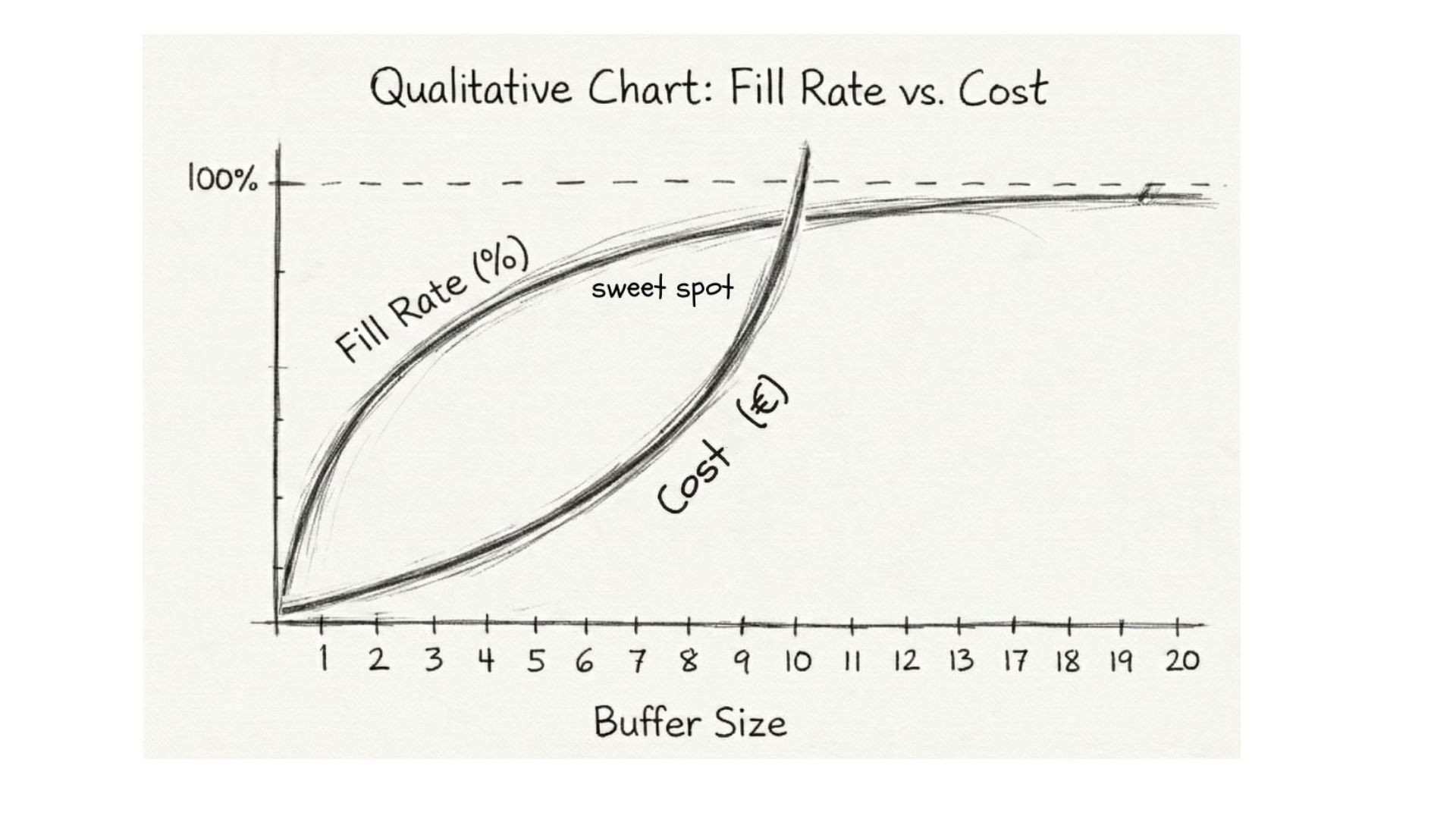
As a rule of thumb, the bigger the buffer the better the stacking. But also, the bigger the buffer the bigger the footprint and the more expensive the solution becomes.
There is obviously a tradeoff here, and we have found the sweet spot.
Buffer: The Pallet’s Hands
The size of the buffer is determined by the length of the physical accumulation zone on the conveyor. It is the number of dimensioned boxes that are not only known, but also are:
- Within reach of the robot
- Not blocked by upstream traffic
- Available for immediate picking
For example, if a system sees 20 boxes upstream in a conveyor (look-ahead), but only 3 are reachable by the robot, your buffer is 3.
The Buffer Effect in Action
Here is a real example from one of our internal simulations:
| Buffer Size | 1 box | 4 boxes | 10 boxes | 20 boxes |
| Fill Rate (%) | 66% | 76% | 85% | 90% |
As the buffer size grows, the algorithm has more combinations to choose from. This allows it to:
- Improve the pallet density (fill rate)
- Interlock shapes for stability
- Balance weight across the pallet
- Reduce overhang and collapse risk
- Take business rules into account
Below, you can visually see the difference the same SKU stream, but with different buffer sizes:
Why a buffer of 4 – 10 is the Sweet Spot
In theory, the larger the buffer, the better the pallet.
In practice, we found a clear sweet spot between 4 and 10.
This range gives:
- Enough carton variety to optimize stacking
- Real-time performance without slowing throughput
- Minimal conveyor footprint
- Low cost and complexity for customers
A larger buffer can further improve density. For example, offline mixed stacking algorithms define the sequence of the products upfront. In essence, this requires a buffer size equal to the order size, which can require a multi-million investment.
According to our findings, for on-the-fly mixed palletizing, a buffer size between 4–10 delivers the best balance between pallet quality, footprint, and overall system cost efficiency.
That is why our mixed palletizing solutions are engineered around this optimal buffer window.
How Progressive Robotics Makes the Buffer Work
The buffer is not just a queue, it is a decision space powered by AI.
Our system combines:
- Industrial-grade 3D vision for real-time dimensioning and detection of damaged cartons.
- AI-Powered Stacking that evaluates stability, weight distribution, and fill density out of random boxes.
- On-the-fly planning so every pick is the best possible choice for the pallet at that moment
- Collision-free motion planning to find optimized robot paths and increase throughput.
What this Means for Your Operation
A well-tuned buffer delivers measurable business value:
- Increased fill rate
- Fewer pallets per shipment
- Reduced transport costs
- Less manual correction and downtime
- Stable and safer pallets
In high-mix logistics environments, that difference compounds across thousands of pallets per month.
The Takeaway
By giving the robot access to 4–10 upcoming boxes, we transform a chaotic stream into a controlled optimization problem.
That is the Buffer Effect.
And it is one of the reasons Progressive Robotics delivers some of the densest, most stable mixed pallets in the industry.
On-the-fly. Unsequenced.
Learn more about our mixed-case palletizing systems, and/or contact us to discuss your palletizing needs with one of our experts.


