It’s no secret that consumer demand today is higher than ever.
And they have transformed palletizing requirements across logistics and distribution sectors. Mixed-SKU pallets are now standard for retail deliveries, e-commerce fulfillment and distribution centers.
Hence, logistics operators face a critical choice between two main approaches.
On-the-fly or sequenced mixed case palletizing?
There’s no one-size-fits-all solution.
Each method offers distinct advantages and limitations which can impact operational efficiency in various ways. Understanding them will help warehouse and distribution managers select the right solution.
This article examines the characteristics, benefits, and drawbacks of both approaches. Your operational requirements will determine which method delivers optimal results.
What is “Sequenced Mixed Palletizing”?
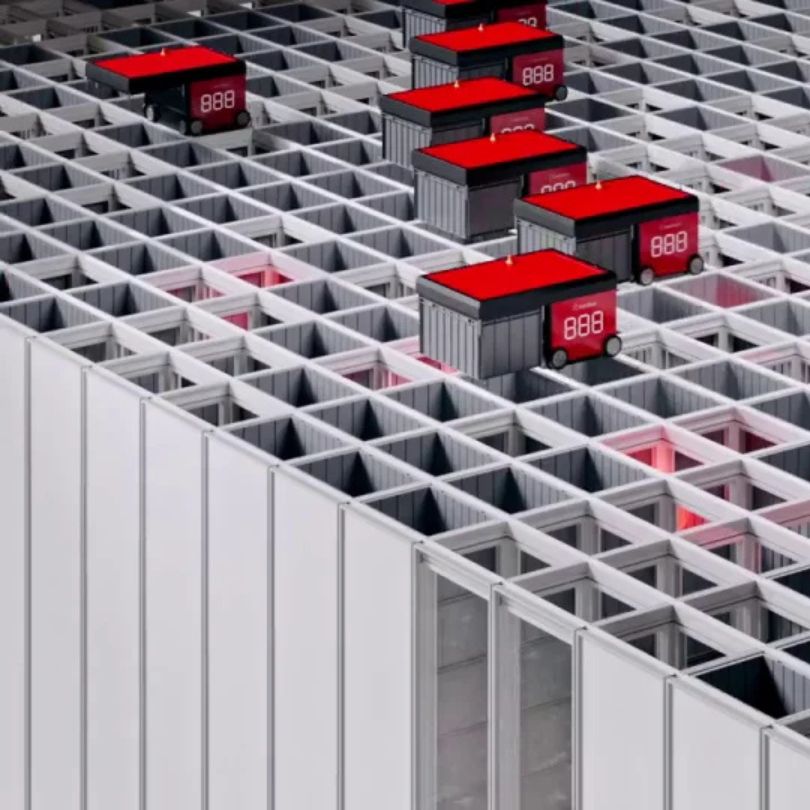
Sequenced palletizing relies on predetermined product arrangement. Items need to reach the palletizing station at a predefined order. This method relies on automated storage and retrieval systems (ASRS) to control this process.
The palletizing robot then places the products according to the predetermined sequence, as complex decision-making happens earlier in the logistics cycle.
The sequencing and the stacking are calculated by a mixed-stacking algorithm with an iterative approach.
Pros of Sequenced Palletizing
- These systems excel in high-volume distribution environments. They benefit large e-commerce fulfillment centers with consistent product flows.
- Predictable operations may reduce errors and stoppages, as fewer decision points limit failure possibilities.
- This established technology offers proven reliability. Many logistics operations trust this approach.
- Load patterns, as repeatedly tested, may increase stability and reduce product damage during transport.
Cons of Sequenced Palletizing
- The sequencing and the stacking calculation happens offline and takes a considerable amount of time per order.
- The larger footprint consumes valuable warehouse space, where accumulation zones take up significant room. Material flow management becomes more complex and requires sophisticated control systems.
- Upstream disruptions can cascade throughout the system and completely shut down operations. For example, if the sequence breaks (a product is missing), the system requires a manual intervention because the recalculation of the stacking takes too long.
- During busy e-commerce seasons (i.e. holidays, Black Friday, Cyber Monday, Halloween), sequencing mechanisms create bottlenecks and huge order completion delays.
Best Applications for Sequenced Mixed Palletizing
- High-volume distribution facilities maximize throughput with sequenced systems. Limited SKU variation simplifies the process.
- Large e-commerce warehouses with predictable flows benefit greatly. They eliminate the need for elaborate, real-time decision-making systems.
- Facilities with existing sorting infrastructure leverage current systems. They avoid significant reconfiguration costs.
- Large retail distribution centers where unexpected events are scarce. They may achieve maximum speed.
What is “On-the-Fly Mixed Palletizing”?
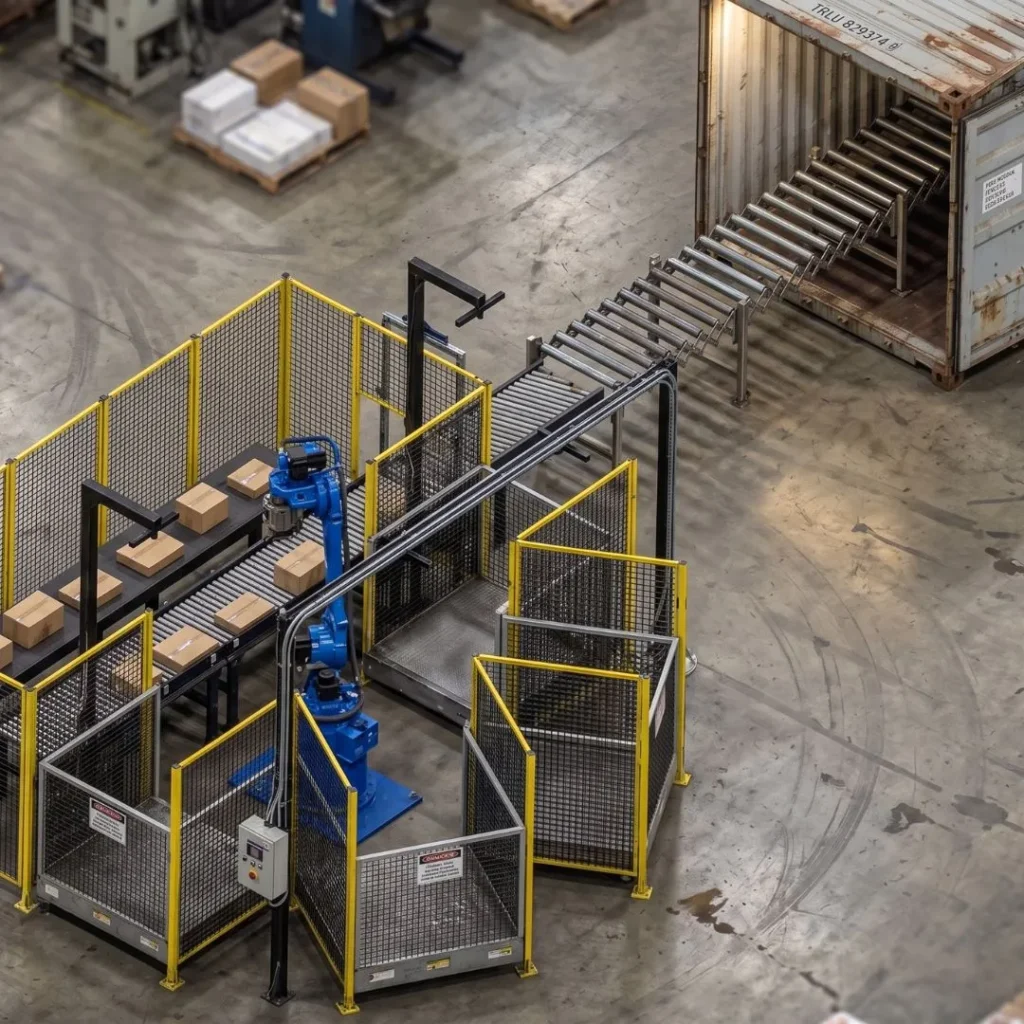
On-the-fly mixed palletizing builds pallets without predetermined product sequencing. It identifies and processes products as they arrive at the palletizing station.
Advanced vision systems recognize incoming items in real-time, instantly determining their dimensions and characteristics.
Then, an advanced stacking algorithm calculates the optimal placement on the pallet, accounting for stability, stacking rules and weight distribution.
This means that products flow directly from picking areas to the palletizing cell, without the need for complex sorting mechanisms.
Pros of On-the-Fly Mixed Palletizing
- This approach offers remarkable adaptability to product variations, since no preparation is needed.
- Order changes flow directly to palletizing without upstream adjustments. This benefits fast-moving e-commerce operations.
- Eliminating accumulation zones also saves valuable floor space in warehouses, where space efficiency is such a major advantage.
- Real-time adaptation handles disruptions in product flow smoothly and allows operations to continue without stopping.
- Simpler infeed systems reduce maintenance needs and mechanical complexity, which lowers ongoing costs.
- As the system processes unexpected products easily, the facilities now have greater flexibility for custom orders.
- Implementation often happens without major changes to existing infrastructure. This reduces installation time.
Cons of On-the-Fly Mixed Palletizing
- Handling may vary greatly between different package types, which can create challenges in e-commerce with diverse products.
- If programming and operation isn’t based on adaptive algorithms and user-friendly software, it can increase implementation, operational and maintenance costs.
- At times and if not chosen according to the specific facilities conditions, vision systems may struggle with reflective packaging or inconsistent lighting.
- Most of the existing on-the-fly stacking solutions have an upper limit on the number of SKUs that they can handle.
Best Applications for On-the-Fly Mixed Palletizing
- Facilities with space limitations benefit from on-the-fly systems. Their compact footprint maximizes available space.
- Operations handling high SKU variety gain efficiency. They avoid complex upstream sorting requirements.
- “Just-in-time” distribution environments palletize directly from picking stations. This streamlines the process flow.
- E-commerce fulfillment centers with diverse package types maintain throughput. They operate without costly sequencers.
- Retail-ready mixed pallet requirements match the flexible stacking capabilities. Vision-guided systems adapt instantly.
- Distribution centers with frequent order changes avoid costly resequencing. Adaptive palletizing responds to demand shifts.
- Logistics providers handling seasonal variations maintain efficiency. They avoid system reconfiguration costs.
As in most cases, no solution is best for all application scenarios. And in modern logistics, the operational conditions become more and more demanding.
This is the reason that many companies started complementing their existing sequenced palletizing systems with the newer on-the-fly approach.
Let’s take a closer look into this increasingly popular trend.
Hybrid Approach: Combining Both Methods for Optimal Results
Modern distribution facilities gain advantages from hybrid solutions, which combine on-the-fly and sequenced palletizing technologies.
Hybrid approaches optimize for both flexibility and throughput. They take advantage of the best attributes and address limitations of each individual method.
E-commerce operations particularly benefit from this combined approach, as they can handle both predictable and variable order patterns.
Example 1: High volume flows can be routed to sequenced palletizing, but lower volume orders or products with high volatility in dimensions can be directed towards the on-the-fly palletizer.
Example 2: On-the-fly palletizing takes over when a sequencing breaks, continuing operation and fast order fulfilment, without requiring manual intervention or product re-routing.
Verdict
As each of the palletizing methods has distinct advantages, your choice should depend on your specific requirements.
On-the-fly systems provide flexibility and space efficiency. Sequenced methods could potentially be faster and more reliable.
Many facilities benefit from hybrid approaches. These combine elements of both methods for optimal performance.
E-commerce operations particularly benefit from strategic palletizing solutions. They face both predictable and variable demands.
As robotic technology advances, the performance gap between approaches narrows. This gives logistics operators more options and is the reason most big distributors centers nowadays switch to hybrid palletizing systems.
Central to this is the robotic palletizing software, which should remove complexity, facilitate integration and palletize any product variation with great efficacy.
At Progressive Robotics, we focus on on-the-fly palletizing with AI-enabled stacking. Our all-in-one software solution combines perception, stacking, and collision-free motion planning to either control a standalone mixed-case palletizing cell or act as the missing element to bring hybrid sequence palletizing to the next level.
Contact us to prepare a demo, customized on your unique palletizing requirements.