Cube storage and high-density robotic storage systems have become one of the most important automation categories in modern logistics, e-commerce, retail fulfillment, and intralogistics.
Warehouses are under pressure to store more SKUs, prepare more orders, reduce walking time, use less floor space, and reduce labor dependency. Traditional racking, manual picking, and aisle-based storage often struggle when operations need both density and speed.
Cube storage systems and high-density AS/RS solutions solve this by turning storage into a dense, automated buffer. Instead of relying on people, forklifts, or long walking routes, inventory is stored in bins, totes, cartons, trays, or pallets and retrieved automatically by robots, shuttles, or automated carriers.
But storage automation is only one part of the warehouse flow.
After goods are stored, retrieved, picked, consolidated, and packed, the next challenge is outbound handling. Cartons and parcels need to be moved, sorted, grouped, and palletized. This is where cube storage connects to the broader automation chain, including mixed palletizing and on-the-fly palletizing systems such as AnyStack® by Progressive Robotics.
The most advanced warehouses are not just automating storage. They are connecting storage, picking, packing, sorting, palletizing, and shipping into one continuous logistics flow.
What Is a Cube Storage System?
A cube storage system is a high-density automated storage and retrieval system, often known as “AS/RS”, that stores items inside a compact three-dimensional structure.
In many systems, robots move across or within the structure to retrieve bins and deliver them to picking, replenishment, or induction stations. The goal is to reduce wasted space, eliminate long walking distances, and increase the speed and accuracy of order fulfillment.
In a broader intralogistics context, cube storage is often discussed together with shuttle systems, goods-to-person systems, pallet shuttles, and high-density robotic storage. These systems may use different architectures, but they address the same operational challenge: how to store more goods, retrieve them faster, and keep warehouse flow predictable.
Cube storage and high-density robotic storage systems are especially useful for operations with:
- High SKU counts
- Limited warehouse space
- E-commerce or omnichannel order profiles
- Frequent picking and replenishment
- Small and medium-sized items
- Pallet storage requirements
- High labor costs
- Demand fluctuations and unpredictable order patterns
In simple terms, they help warehouses answer one question:
How can we store and retrieve more items, faster, in less space?
Why Cube Storage Matters for Intralogistics
Intralogistics is no longer just about moving goods from one point to another. It is about the whole operational flow.
A cube storage (or a high-density AS/RS) can dramatically improve the storage and retrieval side of that flow. It can bring products to operators instead of sending people through aisles. It can reduce the footprint of inventory storage. It can also create a more predictable output from the storage area.
This matters because storage density alone does not create warehouse efficiency. The real value comes when automated storage is connected to picking, packing, sortation, palletizing, and shipping.
That is why cube storage should not be seen as an isolated technology. It is part of a larger intralogistics ecosystem.
The Big 4 in Cube Storage and High-Density AS/RS
1. AutoStore
AutoStore is the company most closely associated with cube storage. In many ways, AutoStore has defined the category.
The AutoStore system uses a dense grid filled with stacked bins. Robots move on top of the grid, retrieving bins and delivering them to workstations. Because there are no traditional aisles inside the storage cube, AutoStore can achieve extremely high storage density. In addition, Autostore’s latest update, AutoCase is an advanced module that enables the handling of both full cases and individual items within a single, high-density grid.
This makes AutoStore especially attractive for warehouses where space is expensive or limited. It is widely used in retail, e-commerce, pharmaceuticals, grocery, and omnichannel fulfillment.
The strength of AutoStore is its maturity. The system is modular, widely deployed, and supported by a large partner network of integrators. For many warehouse automation projects, AutoStore is the default reference point when discussing cube storage.
From an intralogistics perspective, AutoStore is especially strong when the priority is compact storage, SKU accessibility, and goods-to-person picking. It is a strong fit for operations that need to store a large number of small and medium-sized items in a limited footprint while maintaining fast and reliable retrieval.
In March 2026, Supply & Demand Chain Executive reported that AutoStore launched CubeVerse and AutoStore Intelligence as part of its Spring 2026 product update. The update shows how AutoStore is expanding from cube storage hardware into AI-driven fulfillment software, analytics, and optimization.

2. Geek+
Geek+ is one of the leading warehouse robotics companies in the world, with a broad portfolio covering goods-to-person picking, tote-to-person systems, pallet-to-person workflows, sorting, moving, and smart warehouse automation.
Unlike AutoStore, Geek+ is not only focused on a fixed cube-grid structure. Its strength is flexibility. Geek+ systems use autonomous mobile robots and robotic workflows to automate storage, retrieval, picking, sorting, and material movement in a way that can often be adapted to existing warehouse layouts (“brownfield”).
This makes Geek+ especially relevant for operations that want high-density storage and goods-to-person performance without necessarily building a traditional cube storage grid. The company’s solutions can support different fulfillment profiles, from e-commerce and retail to 3PL, manufacturing, and apparel.
Geek+ also fits well into projects where companies want to scale automation gradually. Instead of redesigning the entire warehouse from day one, operations can often introduce robotic workflows step by step and expand as volume grows.
From an intralogistics point of view, Geek+ is important because it shows that warehouse storage automation is moving beyond one fixed architecture. Some companies need maximum cube density. Others need flexible robotic automation that can work around existing processes, layouts, and order profiles.

3. Movu Robotics
Movu Robotics brings a different but highly relevant perspective to high-density storage automation. Instead of focusing only on bins or totes, Movu Robotics is especially strong in pallet automation and shuttle-based storage.
Its Movu atlas system is a 4-way pallet shuttle designed to automate pallet storage in dense racking structures. This makes Movu Robotics particularly relevant for warehouses that need to store and retrieve pallets efficiently, including high-throughput distribution centers, food and beverage operations, cold storage, retail logistics, and 3PL environments.
This is an important distinction. Many cube storage discussions focus on small items, bins, and e-commerce fulfillment. Movu Robotics brings the conversation closer to pallet-level intralogistics, where density, throughput, and automated pallet handling are equally important.
For many operations, pallet storage is still a major space and labor challenge. Manual forklift handling, deep-lane storage, and conventional racking can create inefficiencies, safety risks, and limited throughput. Automated pallet shuttle systems help reduce these issues by moving pallets inside high-density storage structures more efficiently.
Movu Robotics is therefore especially relevant when the warehouse challenge is not only item picking, but pallet movement, pallet buffering, and dense pallet storage. This makes it an important name in the broader discussion around high-density automated storage.

4. KNAPP
KNAPP is one of the most established intralogistics automation companies in the world, with deep experience in shuttle systems, goods-to-person picking, warehouse software, sortation, and complete warehouse automation projects.
KNAPP is not a pure cube storage provider in the same sense as AutoStore. However, it deserves a place in this list because its storage and shuttle systems compete for many of the same automation projects. For many warehouse buyers, the decision is not simply “cube storage or no cube storage.” It is a broader question of which automated storage architecture best fits their order profile, SKU mix, throughput requirements, and space constraints.
KNAPP’s Evo Shuttle is a strong example of this. It is an automated storage and retrieval system for containers, cartons, and trays, designed for high-performance order fulfillment and flexible process design.
This makes KNAPP highly relevant for e-commerce, retail, healthcare, fashion, industrial distribution, and omnichannel operations where speed, reliability, and system integration matter.
One of KNAPP’s strengths is that it approaches warehouse automation as a complete ecosystem. Storage is connected to picking. Picking is connected to packing. Packing is connected to sortation. Sortation is connected to shipping. This end-to-end view is essential in modern intralogistics
In June 2026, MPE Magazine reported that Siemens selected KNAPP’s AeroBot solution for its Karlsruhe site. The system is planned to store containers quadruple-deep across 30,000 locations on 27 levels and use 21 autonomous robots in its final form.

Quick Comparison: The Big 4 in Cube Storage & AS/RS
Company | System Type | Main Strength | Best Fit |
AutoStore | Cube storage AS/RS | Very high storage density and mature ecosystem | E-commerce, retail, spare parts, pharmaceuticals, omnichannel fulfillment |
Geek+ | AMR-based goods-to-person and robotic fulfillment | Flexible automation for existing and new warehouse layouts | 3PL, e-commerce, retail, apparel, manufacturing |
Movu Robotics | High-density pallet shuttle and storage automation | Dense automated pallet storage and pallet movement | Distribution centers, cold storage, food and beverage, 3PL |
KNAPP | Shuttle AS/RS and integrated intralogistics automation | High-throughput storage, picking, software, and system integration | Retail, e-commerce, healthcare, fashion, omnichannel fulfillment |
What are the pros and cons of each cube storage system?
Brand | Pros | Cons |
AutoStore | Space density, Proven ecosystem | Bin-only, Digging delays |
Geek+ | Flexible deployment, Broad portfolio | Lower density, Traffic complexity |
Movu Robotics | Pallet automation, Cold storage | Not item-picking, Integration-heavy |
KNAPP | End-to-end, High throughput | Higher complexity, Higher Investment |
Honorable Mentions
Hai Robotics
Hai Robotics is a major player in goods-to-person automation, especially through its case-handling and tote-handling robotic systems.
Hai Robotics is not always described as a classic cube storage company, but it addresses many of the same warehouse problems: storage density, picking efficiency, flexibility, and labor reduction.
Its systems are especially relevant for operations that want an AS/RS-style solution without necessarily committing to a fixed cube grid. This makes Hai Robotics attractive for warehouses that need modular automation, high storage utilization, and flexible goods-to-person workflows.

Exotec
Exotec is another important company in high-density robotic storage and goods-to-person automation.
Its Skypod system uses autonomous robots that can travel across the warehouse floor and climb vertically within storage racks to retrieve bins and bring them to workstations. This makes Exotec different from classic cube storage systems like AutoStore, where bins are stacked inside a dense grid and robots operate on top of that grid.
Exotec is especially relevant for operations that want high storage density, flexible rack design, fast deployment, and scalable goods-to-person workflows.

Ocado Intelligent Automation
Ocado Intelligent Automation is one of the most advanced names in cubic AS/RS and automated fulfillment, especially because of its deep experience in online grocery.
The Ocado Storage and Retrieval System is designed for high-density storage and high-throughput fulfillment. It comes from an environment where speed, accuracy, temperature control, product variety, and delivery windows are extremely demanding.
Ocado Intelligent Automation deserves an honorable mention because it represents one of the most sophisticated examples of grid-based fulfillment automation. However, it is also a more specialized and ecosystem-driven solution compared with some of the broader warehouse automation providers in this list.

Brightpick
Brightpick takes a different approach to warehouse automation. Instead of relying only on traditional goods-to-person workstations, Brightpick also uses AI-powered mobile robots that can pick and consolidate orders directly in warehouse aisles (“autopickers”).
This makes Brightpick less of a cube storage provider and more of an autonomous mobile picking and fulfillment solution. Still, it belongs in this discussion because it addresses the same strategic goal: reducing manual work, improving fulfillment speed, and creating more flexible warehouse operations.
Brightpick is particularly interesting for e-commerce and grocery fulfillment environments where companies want to automate picking, buffering, consolidation, dispatch, and replenishment with a more mobile robotic approach.

Where Cube Storage Connects to Mixed Palletizing
Cube storage and high-density AS/RS systems are usually evaluated based on storage density, throughput, reliability, workstation productivity, and scalability.
These are all important metrics.
But there is another question warehouse teams should ask:
What happens after goods leave the storage and picking system?
If the downstream process cannot keep up, the benefit of upstream automation is limited. A warehouse may retrieve inventory faster, but still depend on manual labor to stack cartons on pallets. It may automate storage, but still struggle with random mixed-SKU outbound flows. It may improve picking performance, but still need workers to handle repetitive, ergonomic, and physically demanding palletizing tasks.
This is especially true in operations with:
- Mixed-SKU orders
- Variable carton sizes
- Unpredictable outbound sequences
- Multiple stores, routes, or delivery zones
- E-commerce and retail replenishment flows
- High labor dependency at palletizing stations
Traditional mixed palletizing often requires sequencing. The system needs to know the order of cartons in advance so it can build a stable pallet. That usually means more conveyors, buffers, sorting logic, floor space, integration work, and maintenance.
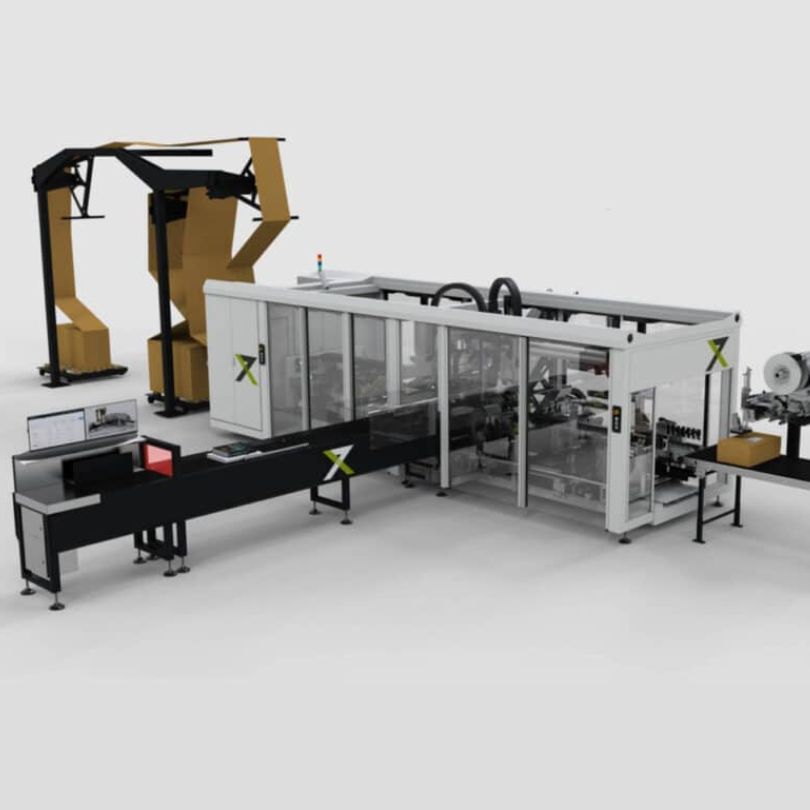
The AnyStack Palletizer by Progressive Robotics takes a different approach.
With on-the-fly mixed palletizing, AnyStack can handle random or variable carton flows and decide how to place each carton in real time. Using 3D vision and advanced AI-powered stacking logic, AnyStack helps warehouses build stable mixed pallets without relying on complex pre-sequencing.
This makes AnyStack a strong fit for automated warehouses where upstream systems create fast, mixed, and dynamic product flows.

How Cube Storage and the AnyStack Palletizer Work Together
A modern automated warehouse can be thought of as a chain of connected processes:
- Storage
- Retrieval
- Picking
- Packing
- Sortation
- Palletizing
- Shipping
Cube storage and high-density AS/RS systems improve the first part of the chain. They make storage and retrieval denser, faster, and more automated. AnyStack streamlines the outbound palletizing by automating the stacking of pallets, especially when the carton flow is mixed or unpredictable.
Together, these systems help create a more complete automation strategy.
For example:
- AutoStore can retrieve inventory from a dense cube grid.
- Geek+ can automate goods-to-person and robotic fulfillment workflows.
- Movu Robotics can support high-density pallet storage and movement.
- KNAPP can integrate storage, picking, software, and fulfillment automation.
- Hai Robotics, Exotec, Ocado Intelligent Automation, and Brightpick can also contribute to faster storage, picking, and fulfillment flows.
- AnyStack can palletize the resulting carton flow without requiring perfect sequencing.
The value is not just in each system individually. The value is in the flow between systems.

What to Consider When Choosing a Cube Storage or High-Density AS/RS System
Choosing a storage automation system is not only a technology decision. It is an operational design decision.
Warehouse teams should consider:
- Storage density: How much inventory can the system hold per square meter?
- Throughput: How many bins, totes, cartons, trays, or pallets can the system process per hour?
- SKU profile: Are the items small, medium, fragile, heavy, fast-moving, or slow-moving?
- Order profile: Are orders single-line, multi-line, e-commerce, B2B, store replenishment, or grocery?
- Pallet profile: Does the operation need carton-level automation, pallet-level automation, or both?
- Scalability: Can the system grow without major disruption?
- Integration: How does it connect to conveyors, packing, sortation, WMS, WES, and ERP systems?
- Maintenance: How easy is it to access robots, shuttles, bins, workstations, and system components?
- Downstream flow: What happens after goods are picked, packed, or consolidated?
- Palletizing: Will outbound palletizing remain manual, sequenced, or automated on the fly?
The last point is often underestimated.
A warehouse can invest heavily in storage automation and still lose efficiency at the palletizing stage. This is why downstream automation should be part of the design conversation from the beginning.
Conclusion: Storage Density Is Powerful, but Flow Is the Real Goal
Cube storage and high-density robotic storage systems have changed the way warehouses think about space, speed, and fulfillment. Companies like AutoStore, Geek+, Movu Robotics, and KNAPP are helping logistics operations move away from manual, aisle-heavy processes and toward denser, more automated intralogistics systems.
But storage is only one part of the logistics puzzle.
The real goal is not just to store more products. It is to move goods efficiently from inbound to storage, from storage to picking, from picking to packing, and from packing to outbound shipping.
That is why cube storage, AS/RS, and robotic palletizing should be considered together.
With AnyStack, Progressive Robotics brings flexible, AI-powered palletizing to the end of the warehouse flow. For operations dealing with mixed cartons, variable SKUs, and unpredictable outbound sequences, AnyStack helps close the gap between automated fulfillment and real-world shipping.
Because in modern intralogistics, automation should not stop when the order is picked. It should continue until the pallet is ready to ship.