Picture this scenario.
You’re presenting a palletizing solution to a food manufacturer.
The client loves the cobots’ safety features and easy programming… Until they see it struggle with their 25kg boxes during peak season, barely managing 5 cycles per minute when they constantly need 10.
Integrators face dilemmas like the above daily.
This article attempts an analysis on which technology excels in real conditions, focusing on:
- payload capacity
- performance speed
- long-term reliability
- total cost of ownership
The decision you are making today could impact your client’s operations for the next decade. Let’s make sure it’s the right one.
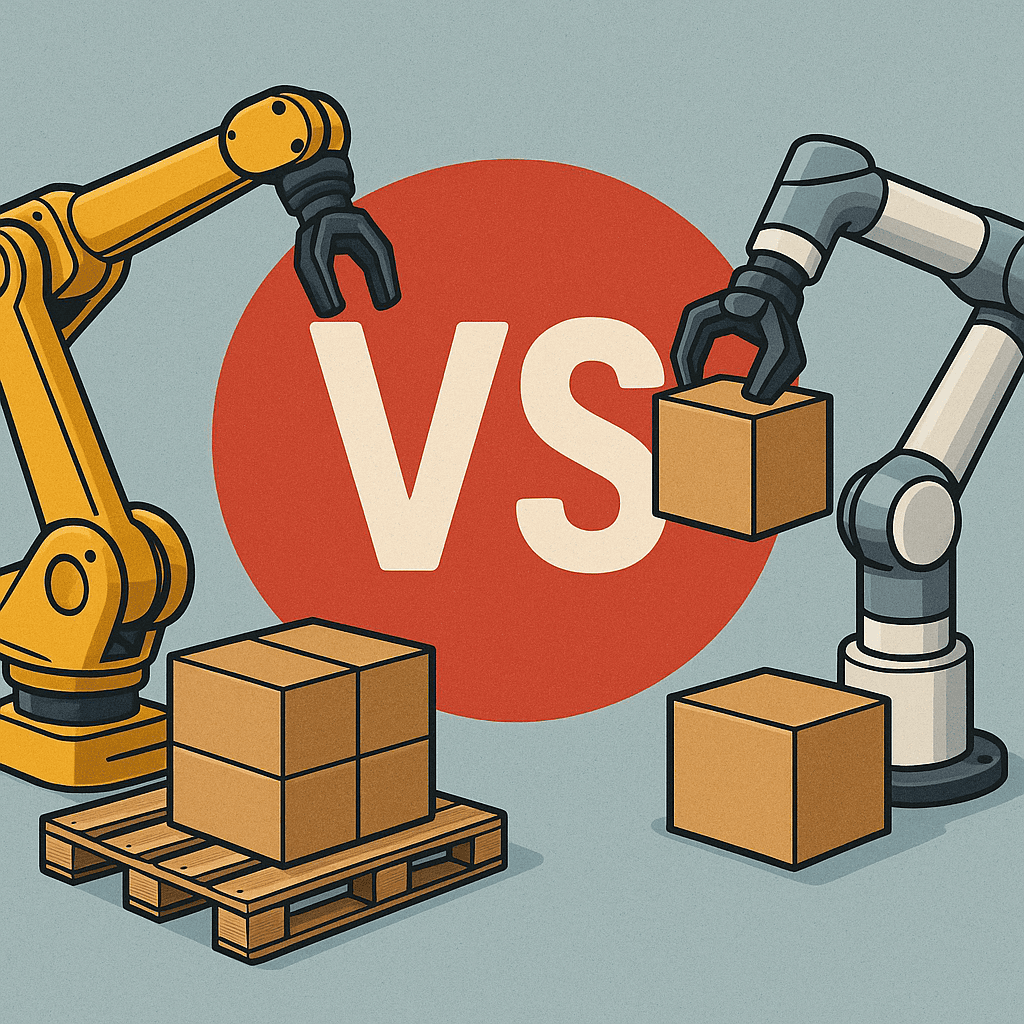
Understanding the alternatives: Core specifications
Collaborative Robots (Cobots)
The latest cobots offer impressive capabilities within defined parameters. Nominal payloads range from 1-35kg, with the sweet spot lying between 5-20kg for most applications.
General reach capabilities extend from 500 – 1,850mm, though for palletizing/depalletizing applications, a minimum reach of 1,300mm is needed for coverage of full pallet placement points. Typically, the 10kg, 20kg, 25kg, 30kg, 35kg payload models abide by this specification. Depending on the pallet height, a lifting column may be needed to help the robotic arm complete full stacks higher than 1,600mm.
Cobots’s most defining characteristic remains their inherent safety features, such as the built-in force limiting and collision detection that reduce fencing requirements.
They also typically excel in programming simplicity. Teach-by-demonstration functionality allows operators to manually guide the robot through desired motions, creating programs without traditional coding.
Finally, the compact size and low weight of the palletizing/depalletizing arms (25-75kg) enables easy installation and allocation of minimum space.
Industrial Robots
Industrial robots present an entirely different value proposition.
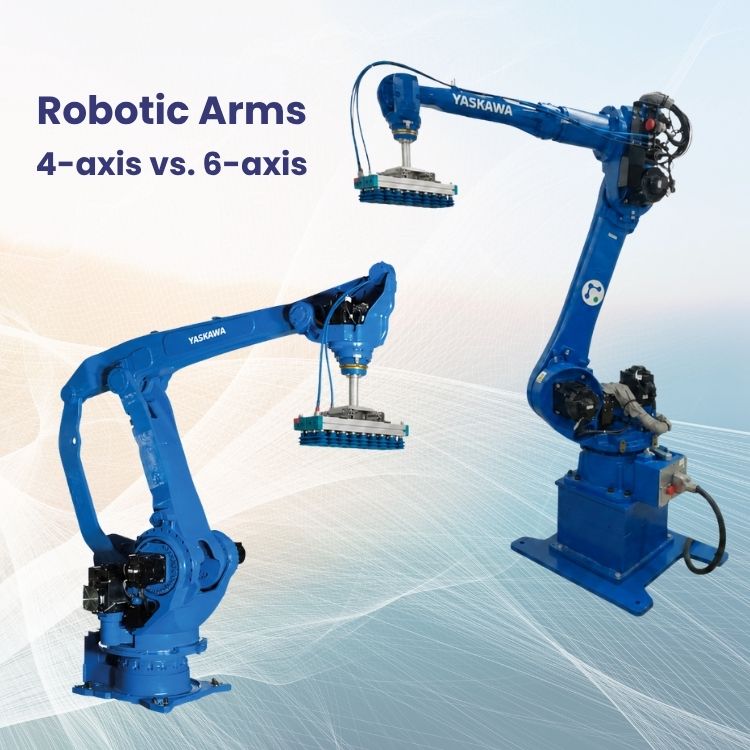
Payload capabilities range from 6kg to over 2,300kg, with palletizing-focused models typically handling 40-500kg effortlessly. Their reach, depending on the robot manufacturer and model, may extend to 4,200mm, ensuring complete pallet height coverage and flexible cell layouts.
Speed represents a critical differentiator. Standard industrial palletizing robots achieve 8-12 cycles per minute consistently. High-speed variants like 4 degrees of freedom palletizing arms can push this even further, defying the laws of physics sometimes.
In most cases, this trade-off increases complexity. Industrial palletizing robots typically require more sophisticated and expensive safety systems, as well as skilled programming, but deliver uncompromising performance in demanding environments.
Performance reality checks
Speed and throughput analysis
Here’s where theory meets the production floor reality.
Cobots face fundamental speed limitations imposed by safety requirements. Even the fastest collaborative robots rarely exceed 9-10 cycles per minute in palletizing applications, with real-world performance often being quite lower, due to acceleration constraints mandated by safety standards.
On the other hand, industrial robots operate without these restrictions. Standard palletizing robots consistently deliver 8-12 cycles per minute. Industrial arms with bigger payload can multi-pick, practically multiplying the production rate by 2x, 3x and even 4x.
For operations benefited by more than 8-9 cycles per minute, industrial robots become economically superior despite higher initial costs. The throughput difference compounds dramatically over time, affecting everything from labor requirements to production capacity.
Payload and handling capacity
Cobots perform adequately with packages under 20kg, but performance degrades significantly as loads approach maximum specifications. More critically, cobots often reduce speed when handling heavy loads, further impacting throughput.
Industrial robots maintain full performance across their entire payload range. A robot rated for 300kg operates as efficiently with 300kg as with 30kg. This consistency proves crucial for operations handling varied product weights or anticipating future product changes.
Workspace and reach considerations
Workspace limitations often determine feasibility and can make other factors irrelevant. Cobots typically struggle to reach above 2.2 – 2.4 meter full pallet heights, constraining pallet configurations and limiting production line layout flexibility.
Industrial robots provide comprehensive workspace coverage, reaching full pallet heights while accommodating multiple pallet positions. This reach advantage enables optimized cell layouts with maximized efficiency.
Of course, when there is extremely limited space, cobots can be the only viable option for palletizing/depalletizing automation.
Long-term performance reliability
This is a critical factor for separating good investments from great ones.
Cobots perform adequately in light-duty applications but may experience mechanical wear under continuous heavy loading. They have only been around for 10-15 years and continue to evolve, but experience shows that their robustness decreases with the harsher the operating conditions get. Moreover, their in-built safety systems, while beneficial, could create maintenance complexity and impact downtime.
On the contrary, industrial robots are engineered specifically for continuous industrial operation. Decades of refinement have produced predictable maintenance schedules and documented reliability metrics. In high-volume environments, this translates to lower total cost of ownership, despite higher initial investment.
Standard palletizing/depalletizing operations, particularly full layer handling and heavy industrial product processing, leverage industrial robot strength and precision advantages.
Economic and integration reality
Total cost analysis
Initial investment comparisons often mislead decision-makers, when they don’t have the appropriate experience in both technologies. For example, while cobots may cost less upfront, hidden integration expenses can equalize initial costs.
Operational cost analysis shows that using cobots may result in higher costs per unit, due to speed limitations in medium to high-volume applications. Industrial robots typically achieve lower cost-per-cycle, when throughput exceeds 8-10 cycles per minute.
Integration factors
Standard cobot advantages include simplified safety requirements and faster deployment. Reduced fencing needs and programming simplicity can accelerate project timelines significantly.
Industrial robot applications can use knowledge from proven integration practices and extensive support infrastructure. The automation industry’s experience with industrial robots provides confidence and predictable outcomes.
Traditionally, industrial robots programming has been much more complex and time-consuming. With the new generation robotics palletizing software, however, this disadvantage tends to disappear.
ROI Considerations
Break-even analysis usually shows industrial robots achieving better Return-Of-Investment (ROI) in applications exceeding 8 cycles per minute. The throughput advantage compounds over time, affecting every aspect of operational economics.
Future-proofing considerations also favor industrial robots for growing operations. Their scalability and upgrade potential protect long-term investments better than cobot limitations.
In a nutshell, we can use the rule of thumb below:
Choose cobots when:
- Payload remains consistently under 15kg
- Speed requirements stay below 6 cycles per minute
- Space constraints severely limit installation options
- Frequent human interaction is required
- Budget limitations prevent industrial robot consideration
Choose industrial robots when:
- Payload regularly exceeds 20kg
- Speed requirements exceed 8 cycles per minute
- Long-term reliability is critical to operations
- Future growth or product changes are anticipated
- Maximum return on investment is prioritized
The gray areas
Medium-weight applications (15-30kg) create the most interesting decision scenarios. While cobots can technically handle this range, industrial robots provide distinct advantages that often tip the scale.
For example, they can be the safer choice when client requirements approach cobot limitations. It’s better to over-specify initially than under-deliver operationally, as the initial cost premium typically pays for itself through improved throughput, longer lifetime and reduced maintenance complexity.
From Comparison to Deployment: Choosing the Right AnyStack Palletizer Configuration
As this comparison demonstrates, there is no universal winner between cobots and industrial robots – only the right solution for a specific application. Progressive Robotics follows the same philosophy with its AnyStack® Palletizer portfolio.
AnyStack Lite combines the flexibility and compact footprint of a collaborative robot with AI-powered palletizing, making it ideal for lower-throughput operations and facilities with limited space.
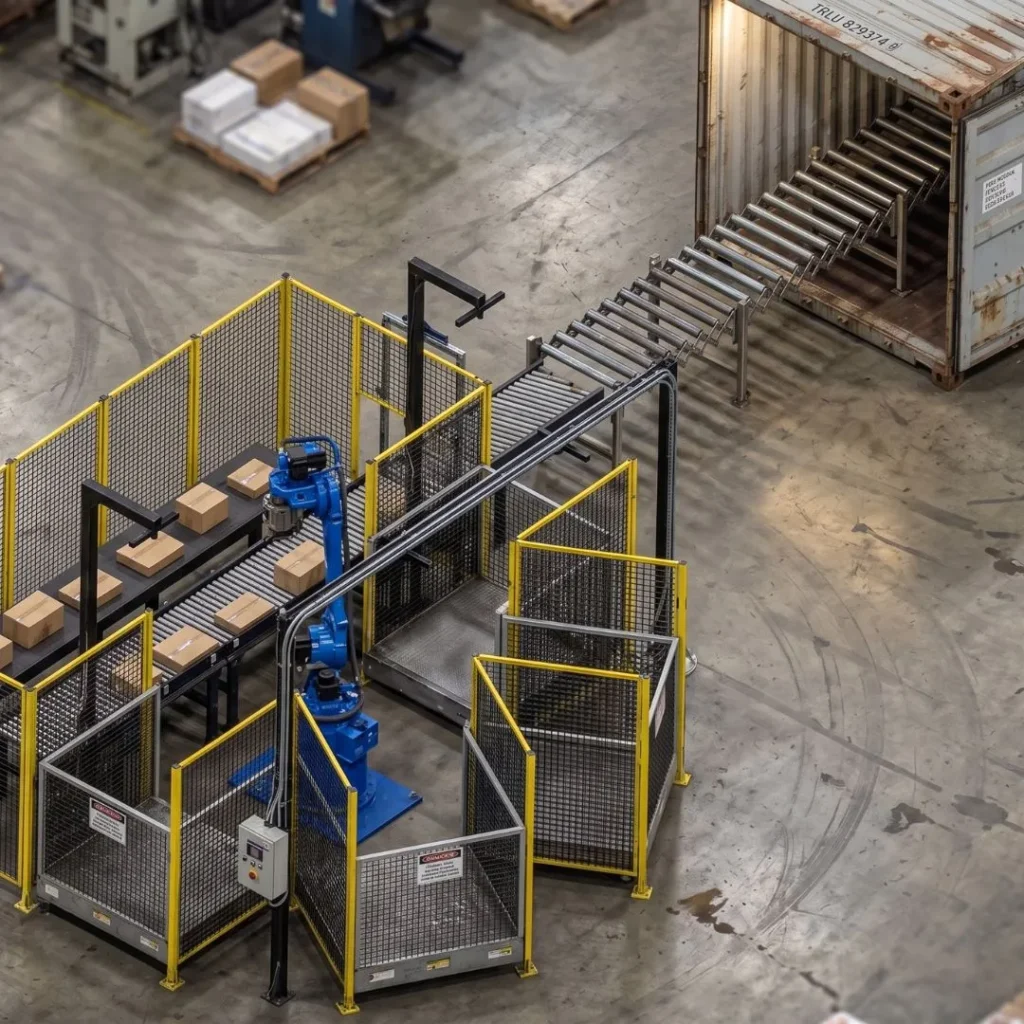
AnyStack Pro uses an industrial robot to deliver higher payload capacity, faster cycle times, and support for more pallet stations in demanding warehouse environments.
Since both systems use the same intelligent vision, stacking, and warehouse integration platform, businesses can choose the configuration that fits today’s requirements while preserving a straightforward upgrade path as production volumes grow.

Conclusion
Both collaborative and industrial robots have earned their place in modern factory automation. However, for palletizing and depalletizing applications, performance requirements often favor industrial robot solutions.
While cobots bring valuable innovations in safety and programming simplicity, industrial robots remain the preferred choice for heavy production environments.
The most successful integrators we know match technology to application requirements rather than following industry trends. For most palletizing applications, that analysis points toward industrial robots, especially now that programming complexity stops being a non-factor.
Ready to make the right investment for your next palletizing project?
Contact Progressive Robotics today for a free consultation and demonstration of our palletizing software. Let us show you how intelligent software can elevate your automation solutions regardless of the robot you choose.